Workbook · Edition 2026
The Cultural Audience Workbook
How to research, respect and reach an audience whose culture isn't your own.
The deck says “target audience.” It doesn't say who that audience trusts. This workbook diagnoses which problem you actually have, context, trust, language, access or reciprocity, before the campaign goes out and the community diagnoses it for you, in public.
Secure checkout. Instant access in My Library. The opening chapters are free to read below.
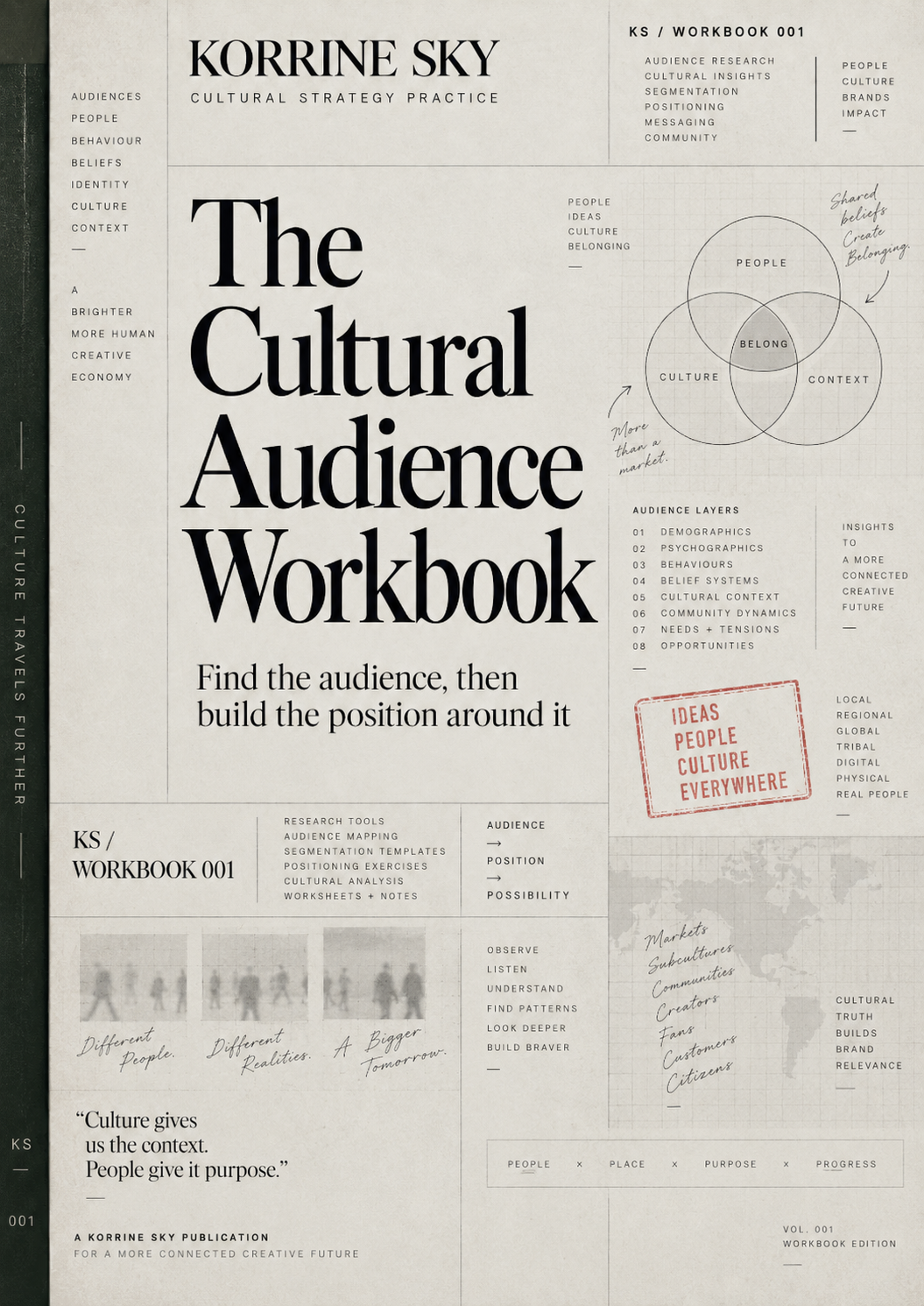
Culture is not a demographic.
What do they already know about people like us, and have we earned the right to ask for their attention?
Who this is for
This is for you if
- A campaign is not landing with the community it names.
- You are entering a market or audience you are not from.
- Engagement looks high and trust or conversion does not follow.
- You need to brief partners on cultural context, not demographics.
- A previous campaign was accused of getting it wrong.
This is not
- A diversity training, a course or a membership.
- A description of any community written for you.
- A promise that a campaign will resonate.
Inside the Workbook
- 01
The Audience Context Canvas
Before you plan how to reach them, map what actually shaped who they are.
- 02
The Cultural Context Map
The same message lands differently depending on what it's arriving into.
- 03
The Trust Map
Reach tells you who can see you. Trust tells you who they'll actually believe.
- 04
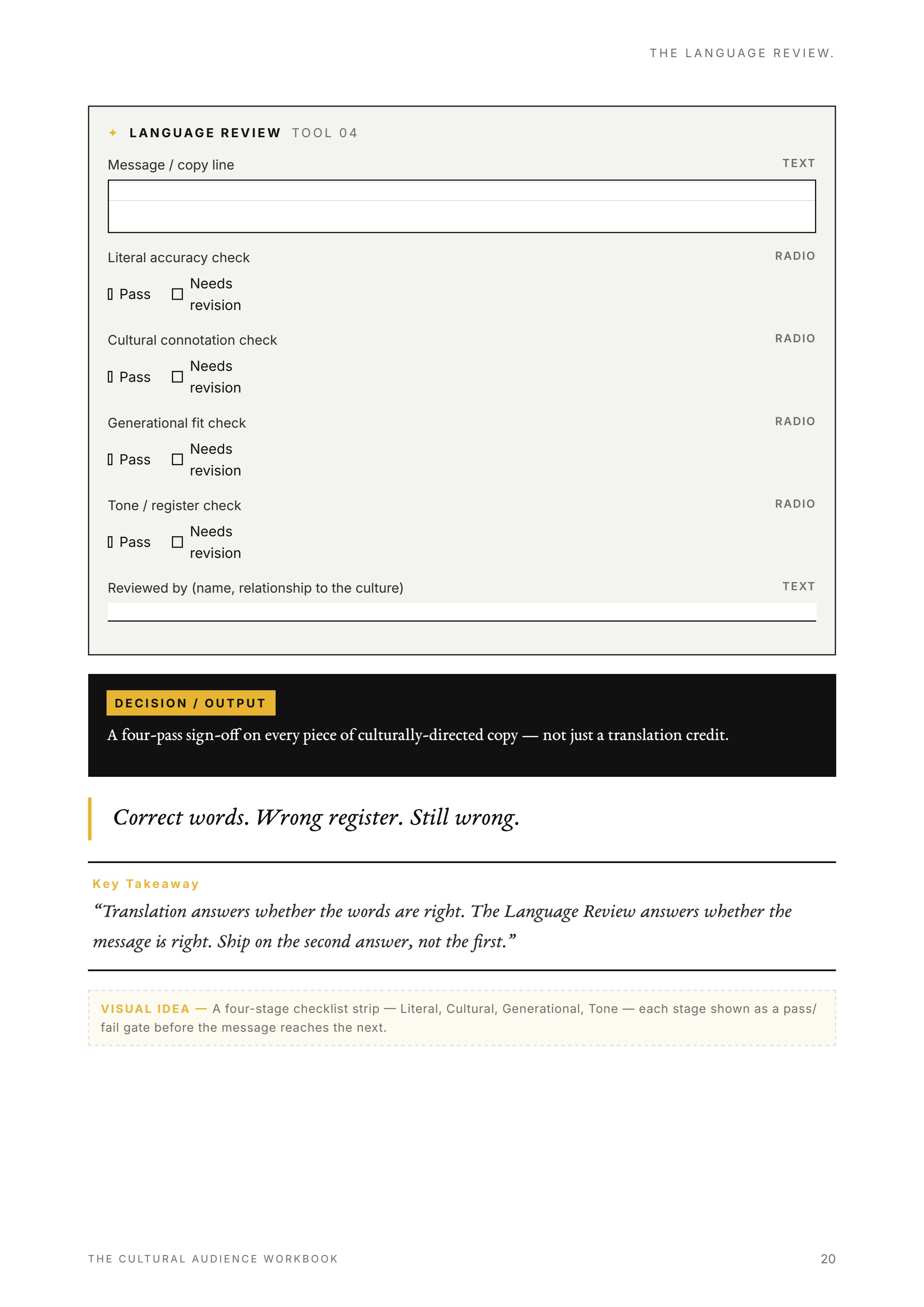
The Language Review
Translation is not the same as being understood.
- 05
The Cultural Signal Inventory
Every community tells you what it values, constantly, if you're listening for it.
- 06
The Community Gateway Map
You don't enter a community. Someone lets you in.
- 07
The Participation Test
Before you ask a community for anything, check whether you're actually ready to be let in.
- 08
Participation, Not Extraction
What you take from a community and what you give back are not the same question.
- 09
The Cultural Channel Journey
A cultural audience doesn't move through a funnel alone, it checks with someone first.
- 10
The Cultural Risk Matrix
Name the specific ways this can go wrong before it goes wrong in public.
- 11
The Cultural Readiness Score
A score that tells you exactly which chapter to return to, not just how worried to be.
- 12
The Final Cultural Audience Plan
Leave with a brief you could hand to someone else and trust them to get it right.
Drawn, not just described
Chapters carry interactive diagrams you can explore as you read. Here is one of them.
Figure 05.1
Where trust actually lives
Trust is rarely held by the brand. Select each layer to see who holds it and what it takes to be let through.
People they know personally
No brand enters this ring directly. You are only ever mentioned here by someone else.
Belief
Select any part to read more
The twelve tools
Every worksheet in the book is also an interactive tool on this site. Each one feeds the next, and the Final Cultural Audience Plan is built almost entirely from what you have already answered.
Tool 01
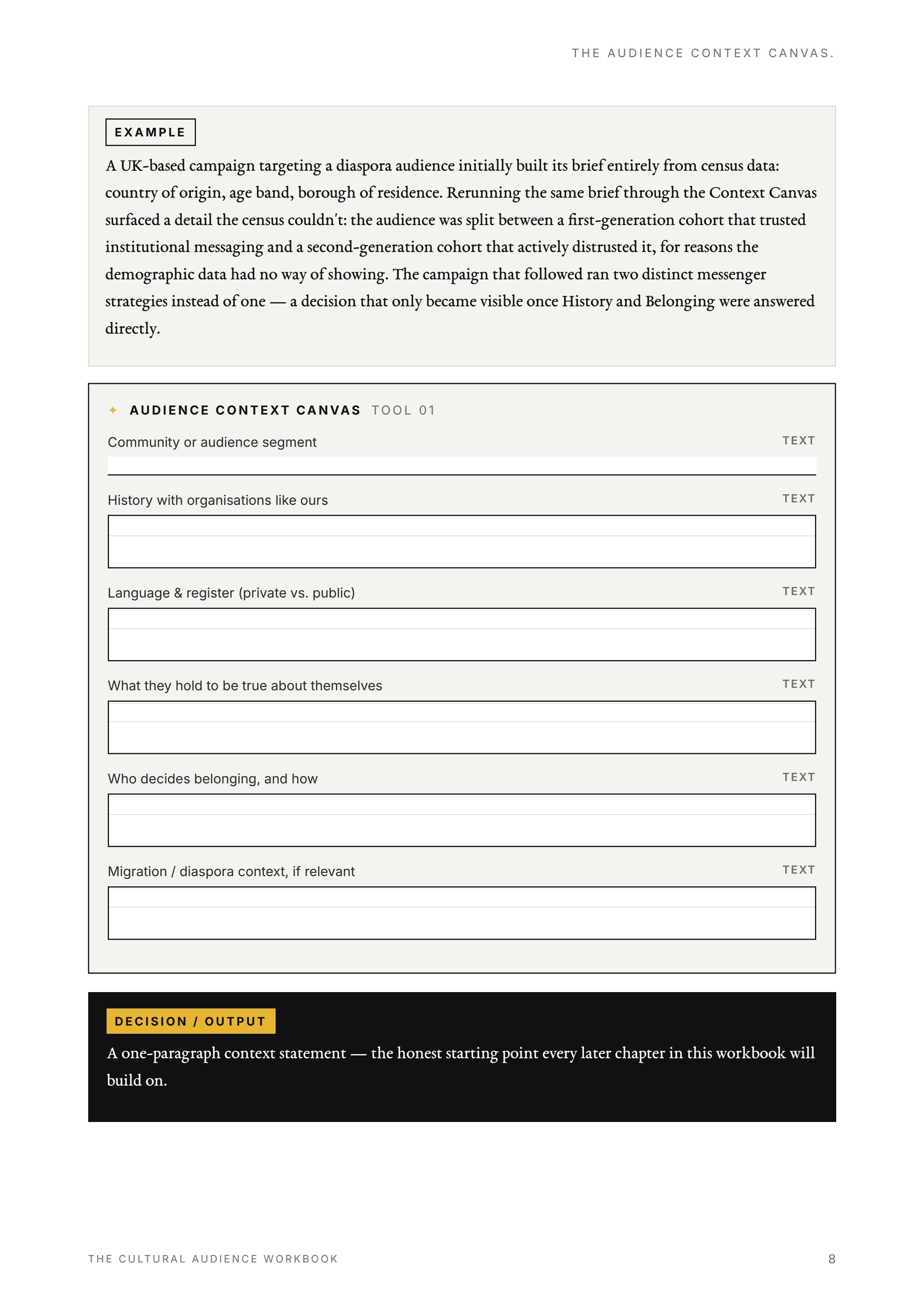
Audience Context Canvas
Before you plan how to reach them, map what actually shaped who they are.
Output: A one-paragraph context statement.
Tool 02
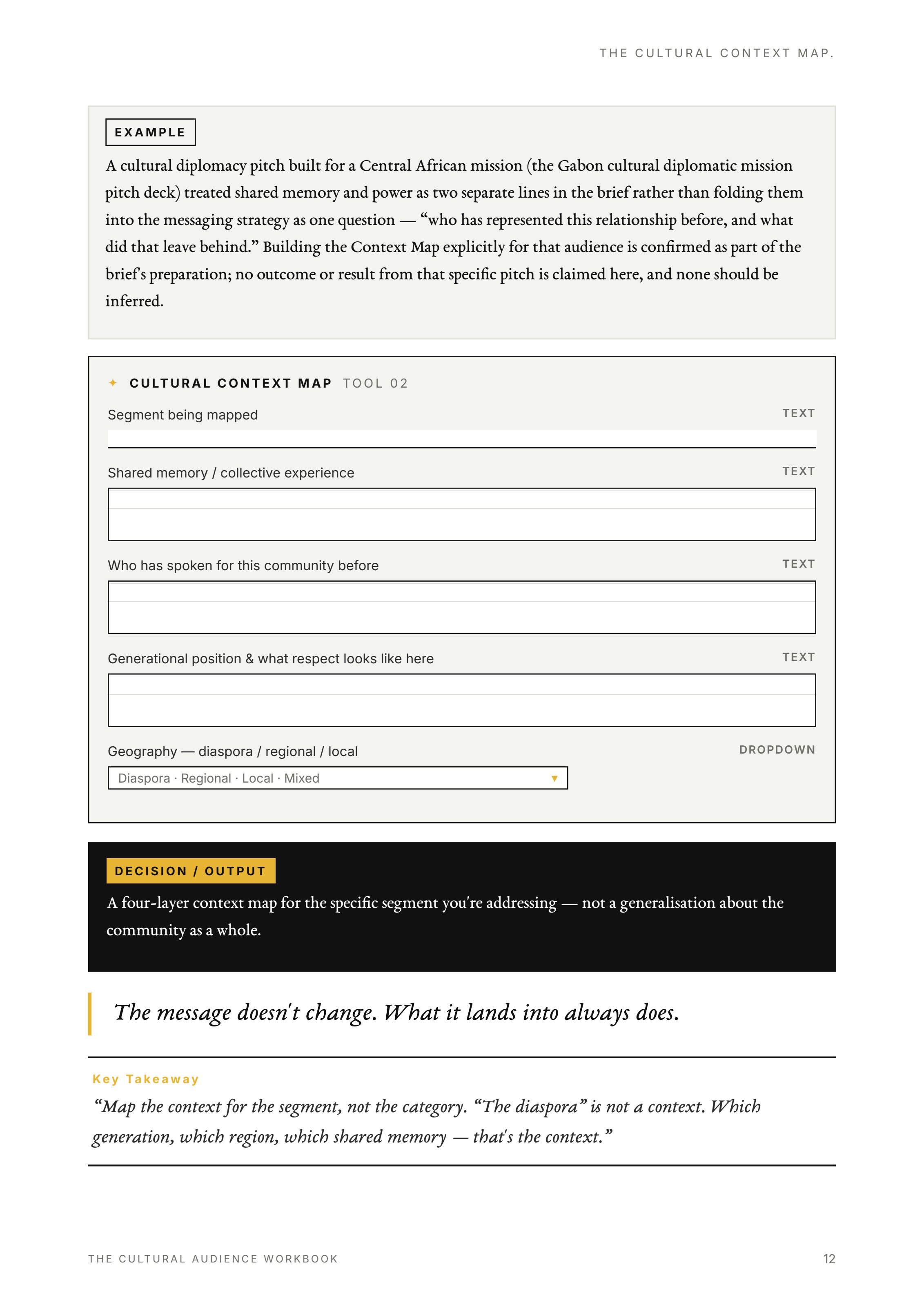
Cultural Context Map
The same message lands differently depending on what it's arriving into.
Output: A four-layer context map for the specific segment you're addressing.
Tool 03
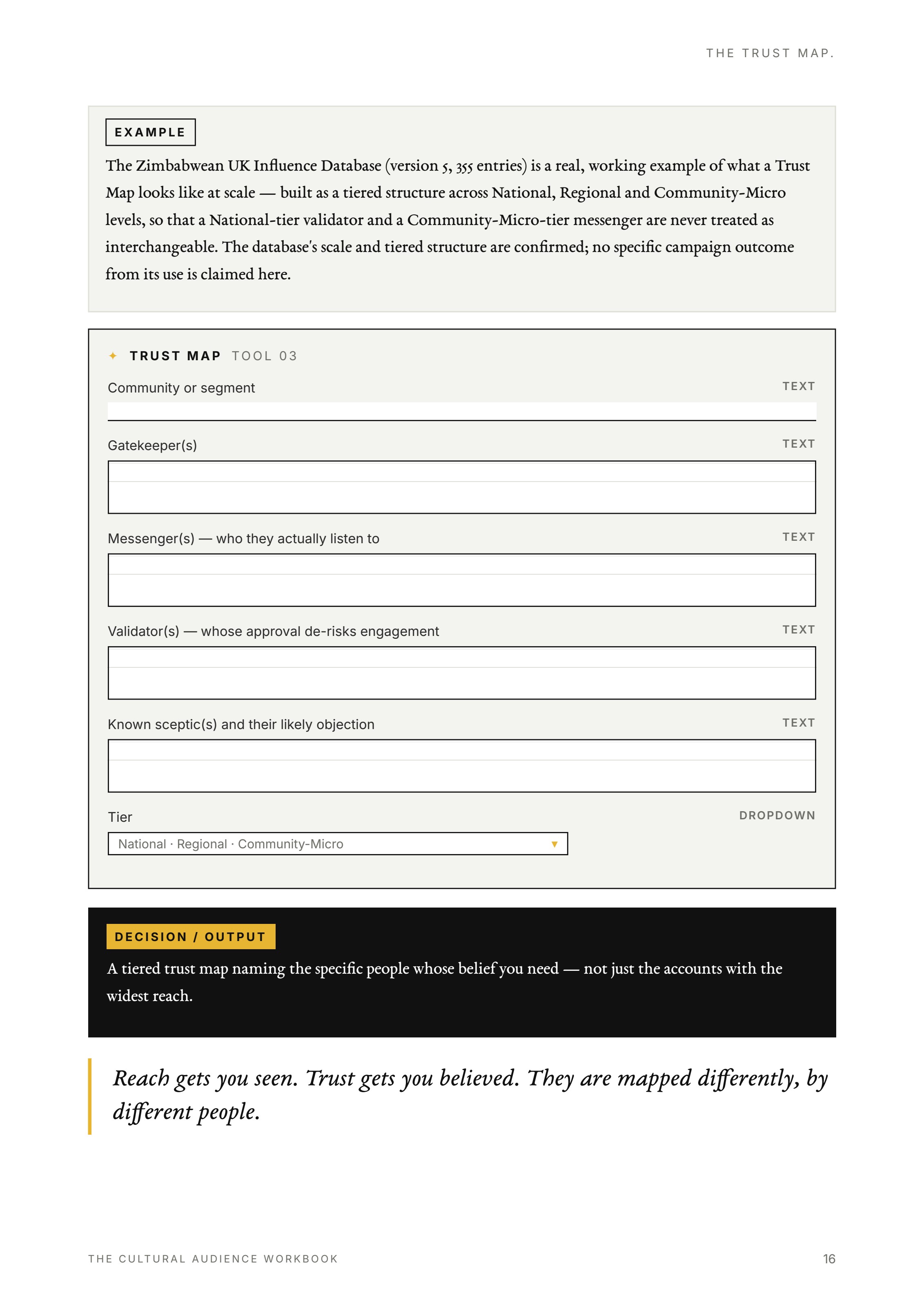
Trust Map
Reach tells you who can see you. Trust tells you who they'll actually believe.
Output: A tiered trust map naming the specific people whose belief you need.
Tool 04
Language Review
Translation is not the same as being understood.
Output: A four-pass sign-off on every piece of culturally-directed copy.
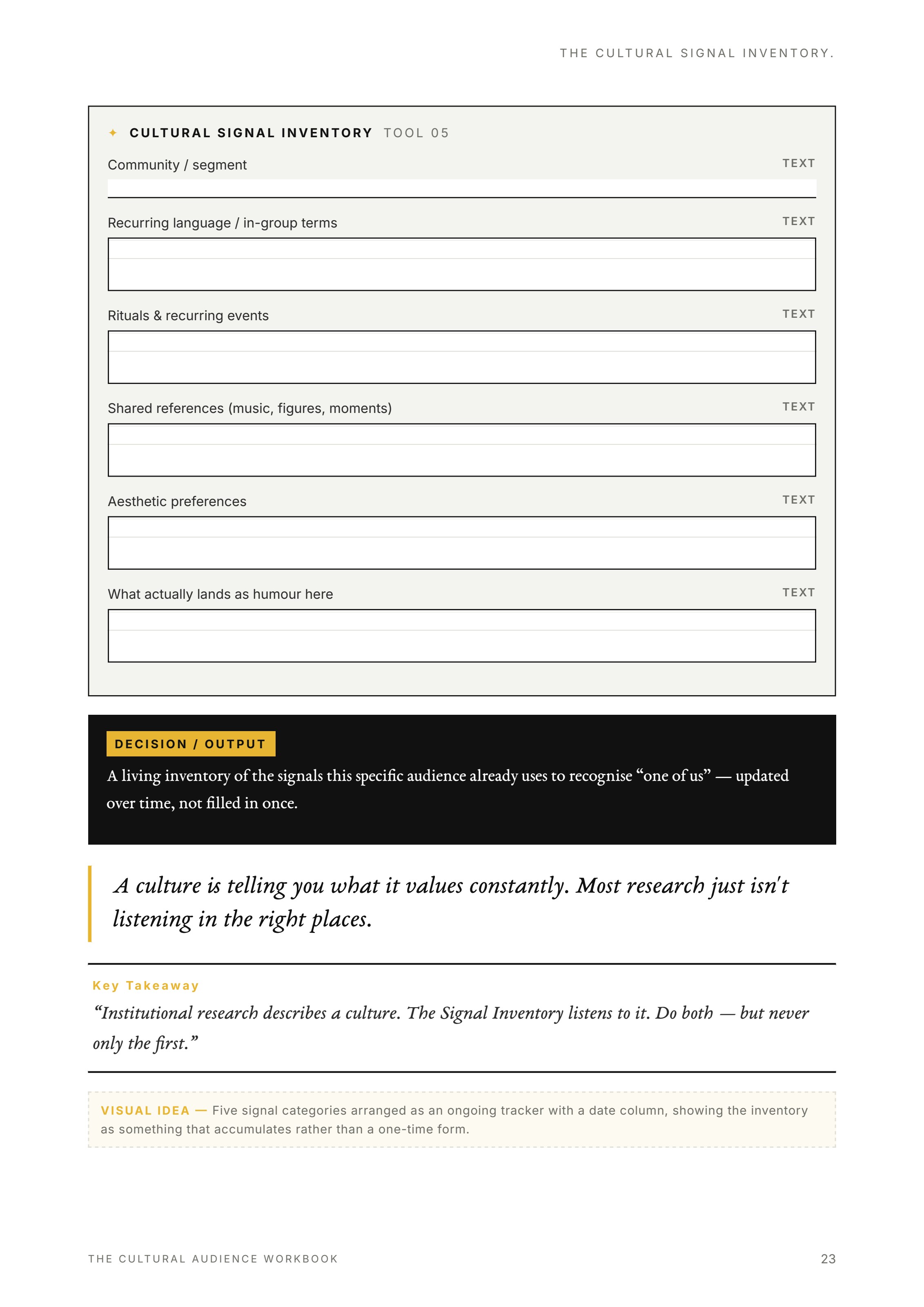
Tool 05
Cultural Signal Inventory
Every community tells you what it values, constantly, if you're listening for it.
Output: A living inventory of the signals this audience uses to recognise “one of us”.
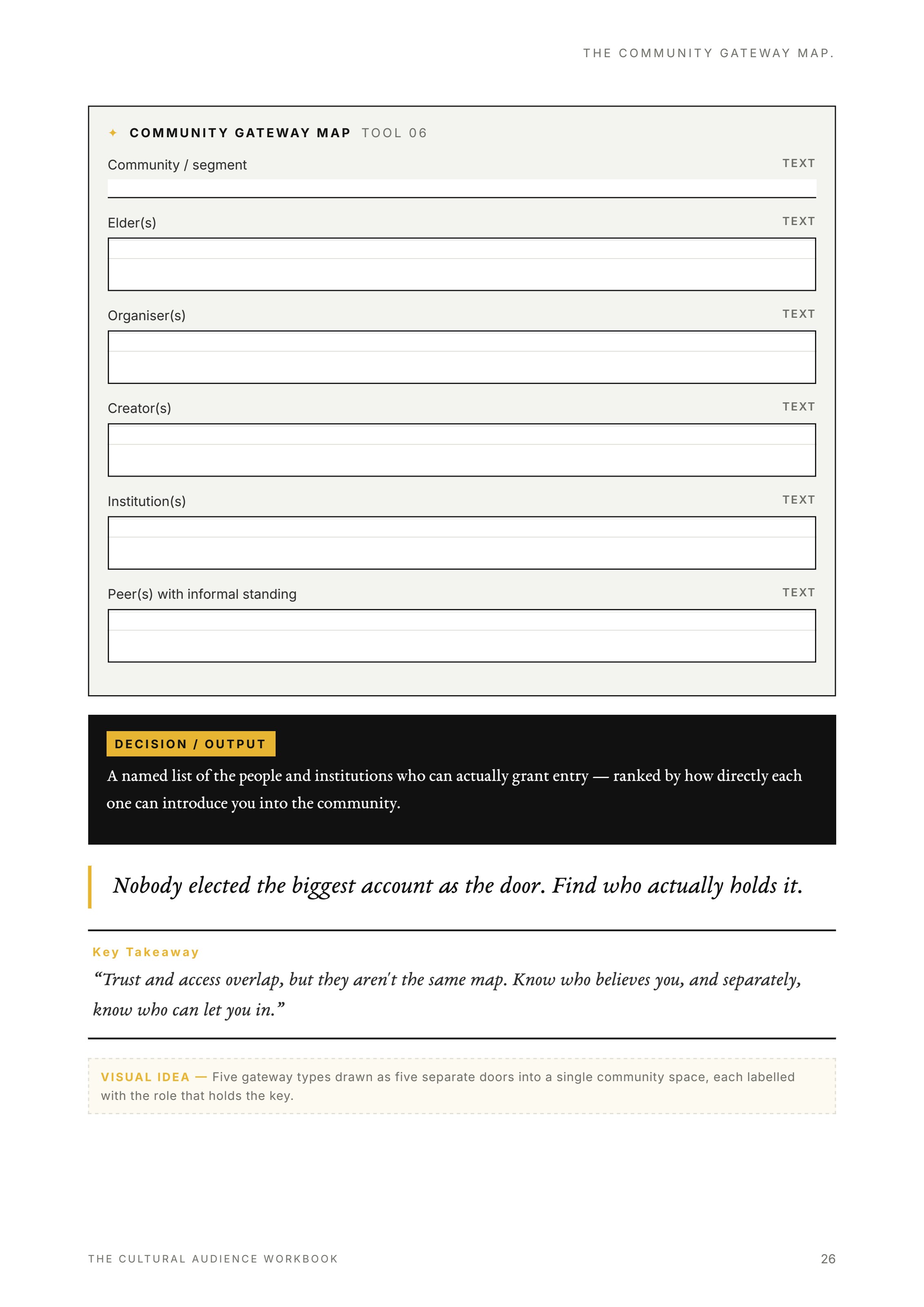
Tool 06
Community Gateway Map
You don't enter a community. Someone lets you in.
Output: A named, ranked list of the people and institutions who can grant entry.
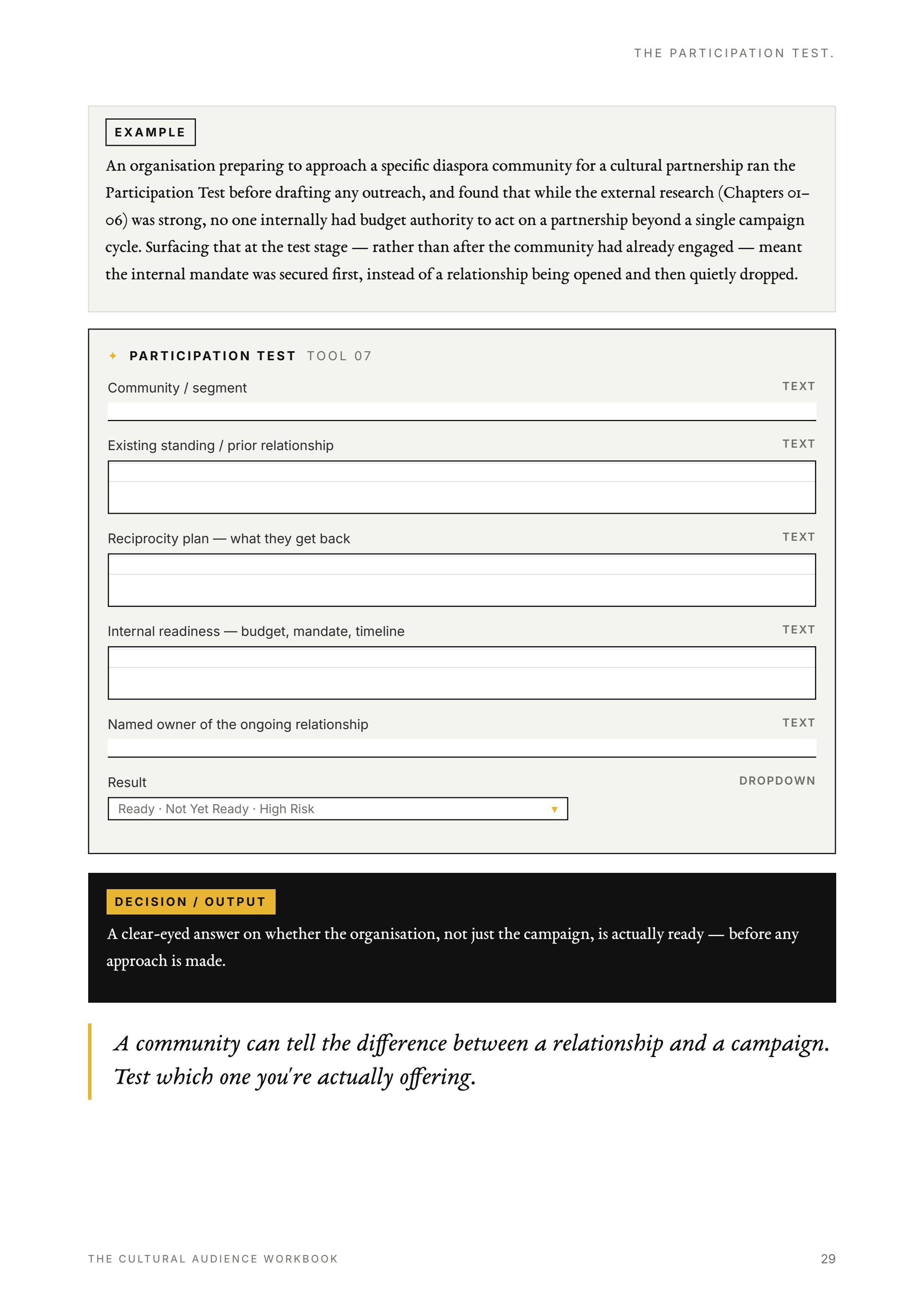
Tool 07
Participation Test
Before you ask a community for anything, check whether you're actually ready to be let in.
Output: A clear-eyed answer on whether the organisation, not just the campaign, is ready.
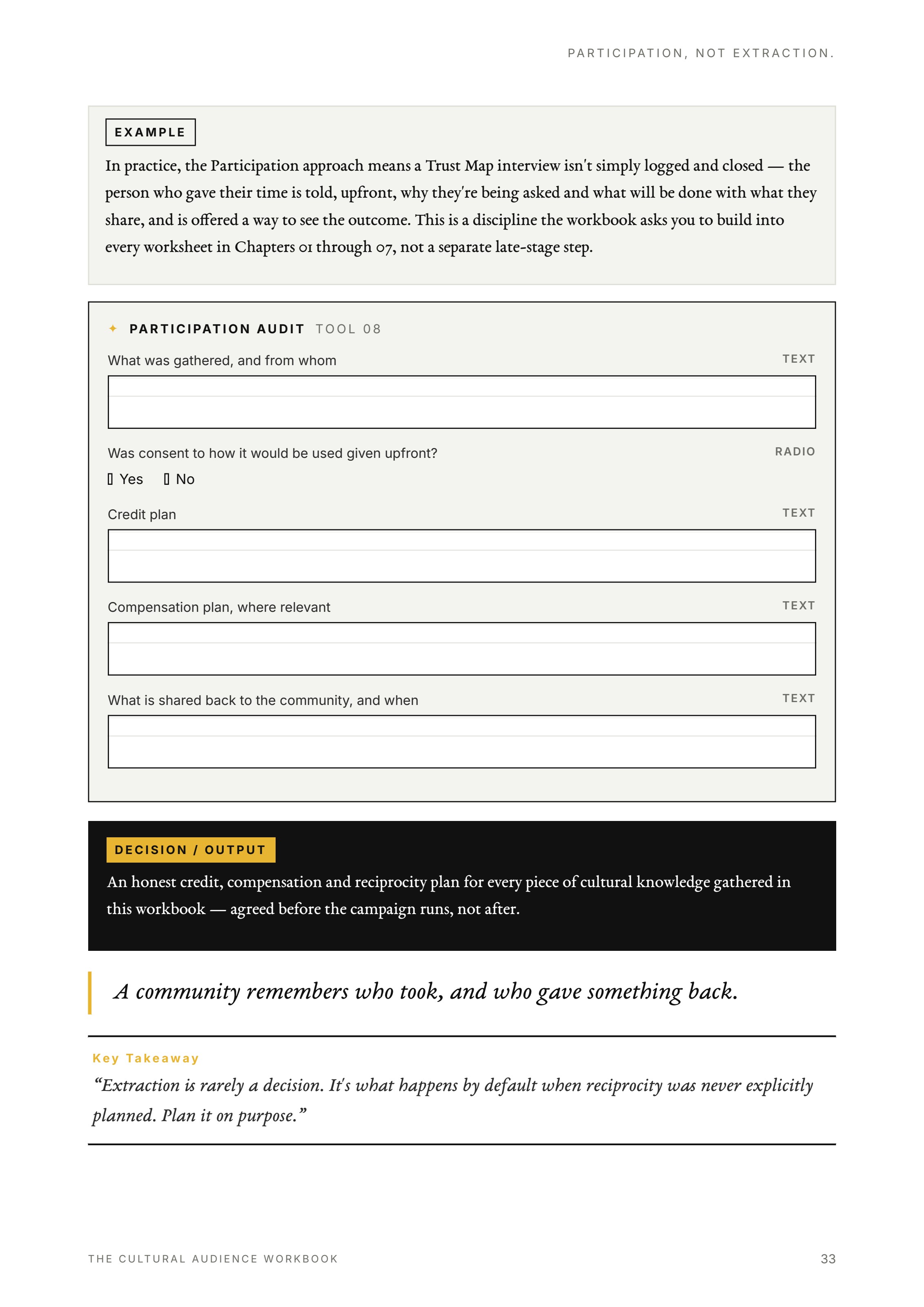
Tool 08
Participation Audit
What you take from a community and what you give back are not the same question.
Output: A credit, compensation and reciprocity plan, agreed before the campaign runs.
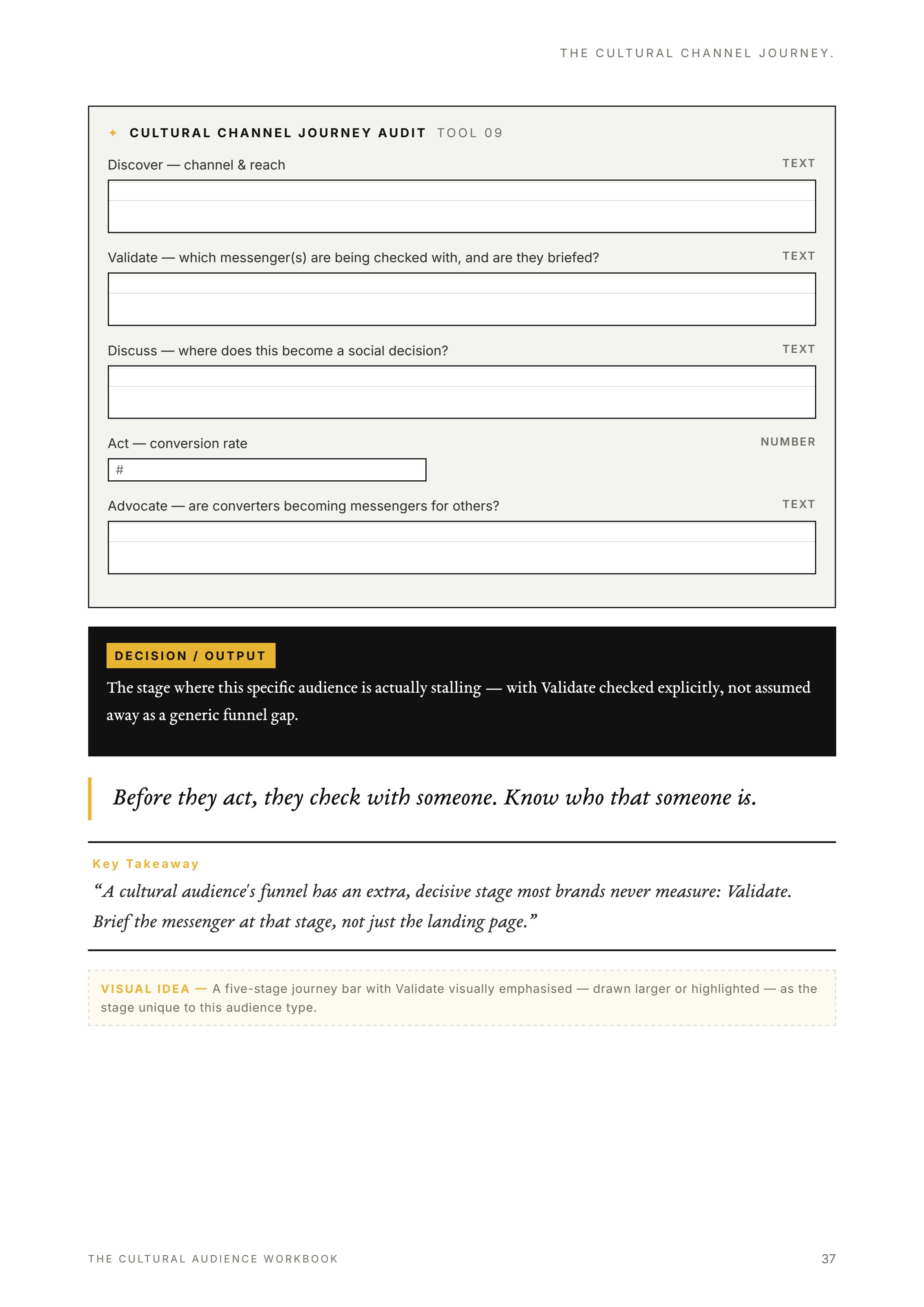
Tool 09
Cultural Channel Journey Audit
A cultural audience doesn't move through a funnel alone, it checks with someone first.
Output: The stage where this audience is actually stalling, with Validate checked explicitly.
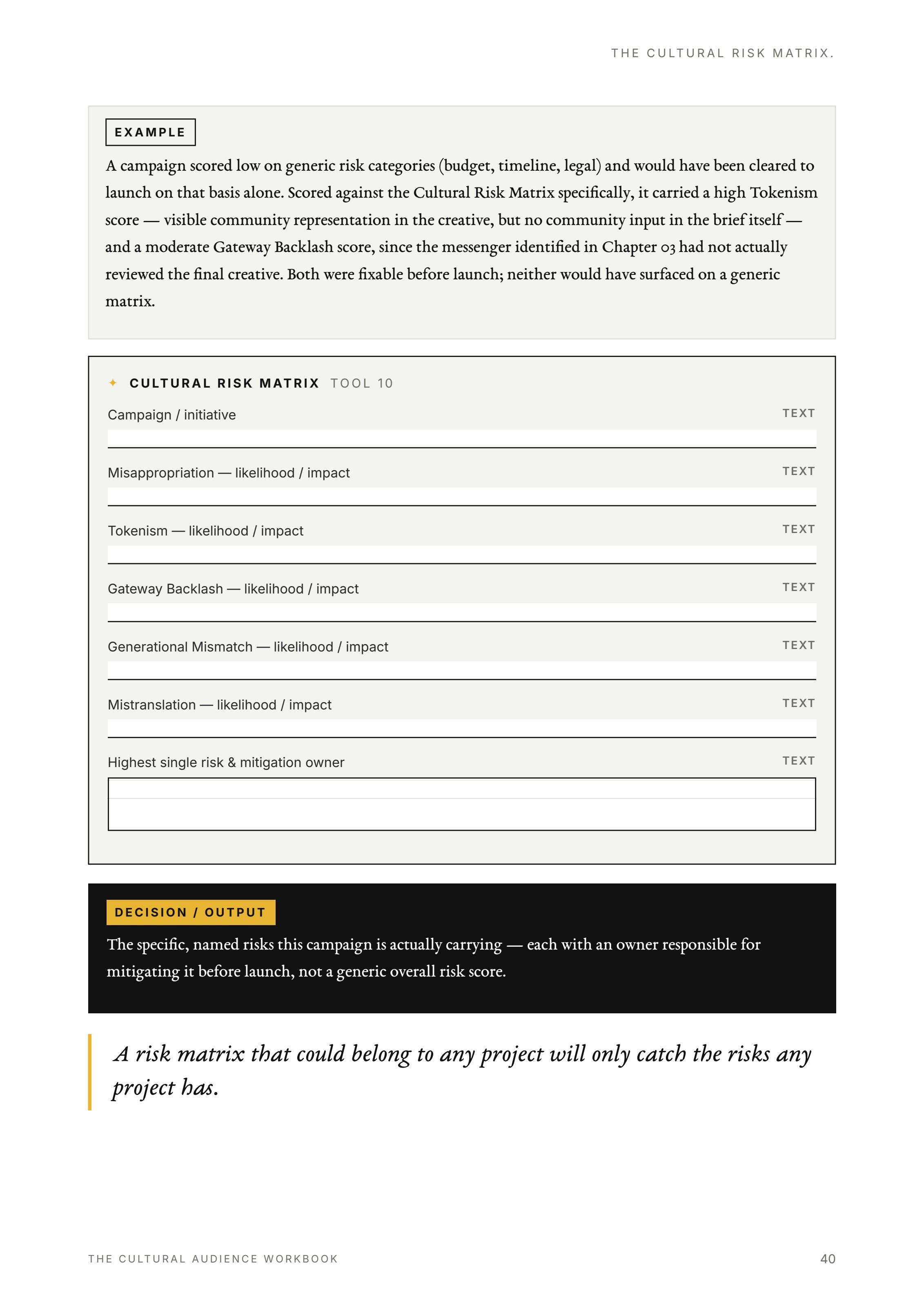
Tool 10
Cultural Risk Matrix
Name the specific ways this can go wrong before it goes wrong in public.
Output: The named risks this campaign carries, each with an owner.
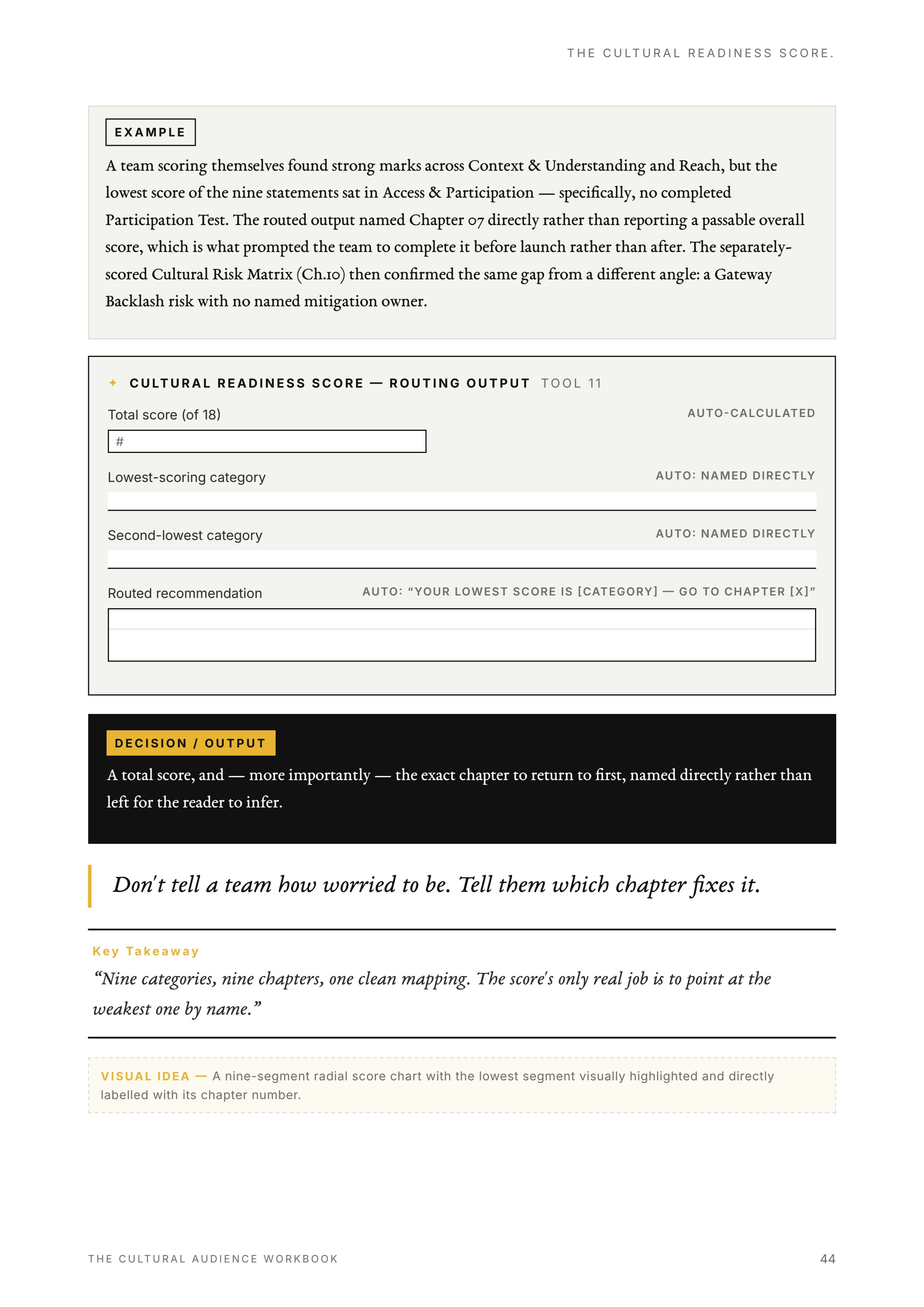
Tool 11
Cultural Readiness Score
A score that tells you exactly which chapter to return to, not just how worried to be.
Output: A total score, and the exact chapter to return to first.
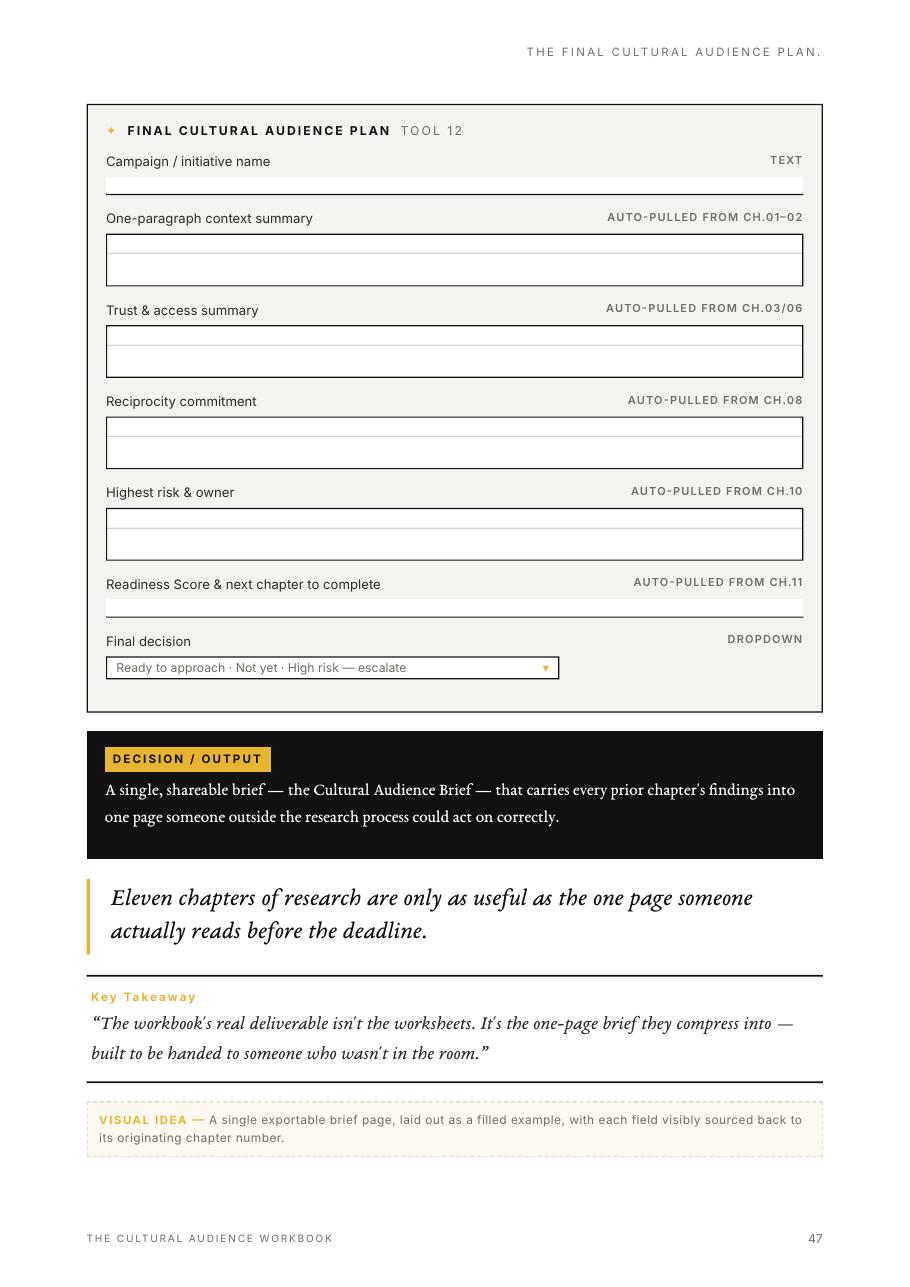
Tool 12
Final Cultural Audience Plan
Leave with a brief you could hand to someone else and trust them to get it right.
Output: A single, shareable Cultural Audience Brief.
Real pages
Every section ends with a decision
Ready
Context, trust and access are genuinely in place.
Not Yet Ready
Something specific is missing and should be corrected before approach.
High Risk
Structural gaps in trust or intent that a better campaign alone is unlikely to solve.
Free to read
The Audience Context Canvas
Before you plan how to reach them, map what actually shaped who they are.
Why this matters
A demographic slide tells you age, location and income. It says nothing about the history a community carries into every interaction with an outside organisation, the language it moves in privately versus publicly, or the specific things it has been promised before and not received. Skip this step and every later chapter, trust, language, access, is being built on a guess.
Common mistake
Treating the demographic brief as the cultural brief. A demographic brief answers “who are they.” A cultural brief answers “what shaped how they'll receive us.” Organisations that stop at the first question consistently produce campaigns that are accurate and still wrong.
The Audience Context Canvas
Five questions, answered honestly before anything is written:
- 01
History
What has this community experienced from organisations like ours before, and what did that leave behind?
- 02
Language
What language, register and code do they use with each other, and what changes when an outsider is in the room?
- 03
Belief
What do they hold to be true about themselves that a generic campaign is likely to get wrong?
- 04
Belonging
Who decides whether someone belongs, and on what basis?
- 05
Migration
Is this a community defined by movement, diaspora, migration, displacement, and if so, what does that do to identity, language and trust?
The rest of this chapter, its worksheet and the remaining eleven chapters are in the full Workbook.
Questions
- Is this a diversity or inclusion training?
- No. It is a research discipline for reaching an audience whose culture is not your own, run before the brief is written rather than after a campaign is questioned.
- Who is it for?
- Brand and marketing teams, promoters, cultural institutions, agencies and organisations planning to approach a cultural audience that is not their own.
- Will it tell me what a community thinks?
- No, and it never should. The tools structure your own research. Every cultural answer comes from the people you actually asked, recorded with consent, credit and reciprocity.
- What do I actually get?
- The complete web edition, the downloadable PDF, twelve interactive tools, private research workspaces for each audience, and exports of your completed workbook, readiness report, risk register and one-page Cultural Audience Brief.
- Do I need an account?
- Yes, so your research and progress are saved and available on any device. Your account is created at checkout.
- Will it be updated?
- Yes. Buying the Workbook gives you lifetime access to this edition and every update to it.
Want this run on your audience with me in the room? See the Cultural Audience Audit.
Do the research before the brief
£39. Lifetime access. Web edition, PDF and twelve interactive tools.
Already bought it? Open it in My Library.