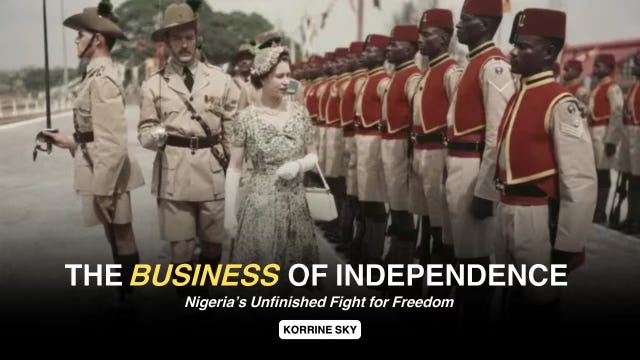
The Business of Independence: Nigeria’s Unfinished Freedom
Korrine Sky · October 2025 · 5 min read
Independence is a word that carries hope. It promises liberation, self-determination, dignity. For Nigeria, October 1st, 1960, is remembered as that moment, the day political independence was achieved. But history shows
Listen to this essay
Narrated version
Independence is a word that carries hope. It promises liberation, self-determination, dignity. For Nigeria, October 1st, 1960, is remembered as that moment, the day political independence was achieved. But history shows us a more complicated truth. Independence was never complete.
When Britain departed, it did not leave Nigeria as a free nation. It left behind the architecture of control: borders drawn for profit, not people; governance structures designed for foreign advantage; economies built to serve extraction, not growth. Nigeria’s independence is not a single date. It is part of a centuries-long story of conquest, exploitation, resistance, and survival.
Culture & Commerce is a reader-supported publication. To receive new posts and support my work, consider becoming a free or paid subscriber.
To understand where we are today, we must return to the 1800s, to the origins of Britain’s colonial project in Nigeria.
The Birth of Colonial Nigeria
Before Nigeria existed as a political entity, it was home to hundreds of kingdoms, empires, city-states, and trading networks. The Sokoto Caliphate in the north stretched over vast territories, the Oyo Empire in the west thrived as a centre of culture and trade, and the Benin Kingdom in the south was famed for its art, governance, and economic organisation. These were sovereign states with their own systems of law, governance, and commerce.
British influence began through trade rather than conquest. In the early 19th century, Britain was deeply involved in the transatlantic slave trade. When Britain abolished slavery in 1807, its attention shifted to controlling the trade of goods that would feed its industrial expansion. Palm oil became central to this new phase of commerce. Indigenous to the Niger Delta, palm oil was essential as an industrial lubricant, and it became one of Britain’s most valuable commodities.
British traders and chartered companies, most notably the Royal Niger Company began to establish control in Nigeria. They built trade posts, negotiated “treaties,” and established agreements that ceded control over land and resources. But these treaties were rarely fair. They were negotiated under duress, often in languages and contexts the signatories could not fully understand. They became tools for justifying full colonial control.
By the mid-19th century, Britain’s commercial influence in the Niger Delta and beyond had deepened. The Royal Niger Company operated almost as a state within a state, with its own courts, police, and armies. This was not a form of governance designed to prepare Nigeria for independence, it was the governance of a corporation designed to protect profit.
Resistance and Conquest
This expansion did not happen without resistance. Leaders such as Jaja of Opobo, a former slave who became one of the wealthiest palm oil traders in the Niger Delta, understood the stakes. He resisted British control of trade and challenged their monopoly. King Koko of Nembe similarly resisted.
These acts of defiance were not tolerated. Britain responded with military force, bombardments, and massacres. Leaders were deposed, exiled, or assassinated by poisoning. Entire communities were uprooted. By 1900, Nigeria was formally a British colony. The Royal Niger Company’s territories were reorganised into the Northern and Southern Protectorates.
In 1914, Britain merged these territories with Lagos Colony to create Nigeria. This amalgamation was not born of Nigerian self-determination. It was a decision made in London for administrative convenience and imperial efficiency. The borders drawn then grouped hundreds of ethnic and cultural groups with little regard for their differences or histories. This artificial geography became one of colonialism’s most enduring legacies.
Colonial Rule and the Architecture of Control
Colonial administration was designed to build a nation, but to extract its wealth. Infrastructure such as railways, ports, and roads were built primarily to move raw materials to Britain, not to integrate Nigeria’s internal economy. Taxation systems forced Nigerians into labour. Education was structured to produce clerks and low-level administrators for the colonial state rather than leaders for self-rule.
Indirect rule, introduced by Lord Lugard, preserved local rulers but subordinated them to colonial authority. This system entrenched divisions along ethnic and regional lines, sowing the seeds of conflict that continue to trouble Nigeria today.
Economically, Nigeria was tied to the needs of the British empire. Raw materials; palm oil, cocoa, groundnuts, tin, were exported cheaply, while manufactured goods were imported. This established a dependency that has never been fully reversed.
The Road to Independence
By the mid-20th century, nationalist movements were gaining momentum across Africa. In Nigeria, these movements took many forms: political parties, labour strikes, student activism, and regional campaigns. Leaders such as Nnamdi Azikiwe, Obafemi Awolowo, and Ahmadu Bello articulated visions of self-rule.
Yet independence was not simply the result of these struggles. It was also a decision by Britain, influenced by the costs of maintaining empire after World War II, and the global tide turning against colonialism. On October 1st, 1960, Nigeria achieved political independence.
But the structures of colonial rule remained. Borders drawn without consent persisted. Governance systems built for colonial control continued. Economies remained dependent. Independence became not a full liberation but a new chapter in a long story.
The Legacy of Empire Today
More than sixty years later, Nigeria still lives with the consequences of colonisation. Debt continues to enslave nations. Economies remain structured for export, not self-sufficiency. Borders still divide rather than unite. Even the way independence is remembered is shaped by a narrative written by the coloniser.
Colonisation was brutal, systematic, and bloody. Yet the Commonwealth, the organisation that emerged from empire, is celebrated, a club of colonised nations that preserves the structures Britain established.
Nigeria’s independence remains unfinished. Independence Day should not be a celebration alone. It should be a challenge: a challenge to finish what was started, to reclaim what was stolen, and to write the true story of Nigeria’s freedom.
About this Series
Hi, my name is Korrine. I am a storyteller. For the next 30 days, I will be writing a series uncovering untold Black history, stories erased, overlooked, and hidden. This is not just history. This is a journey of truth, legacy, and reclaiming our narrative.
Follow along. Share your thoughts. Join the conversation. Let us rewrite history together.
Culture & Commerce is a reader-supported publication. To receive new posts and support my work, consider becoming a free or paid subscriber.
Culture & Commerce
Get the next essay first.
Culture, brand power and influence, read straight from my desk. No spam, unsubscribe anytime.
Prefer Substack? Follow Culture & Commerce there.
Originally published in Culture & Commerce. Read the original post.