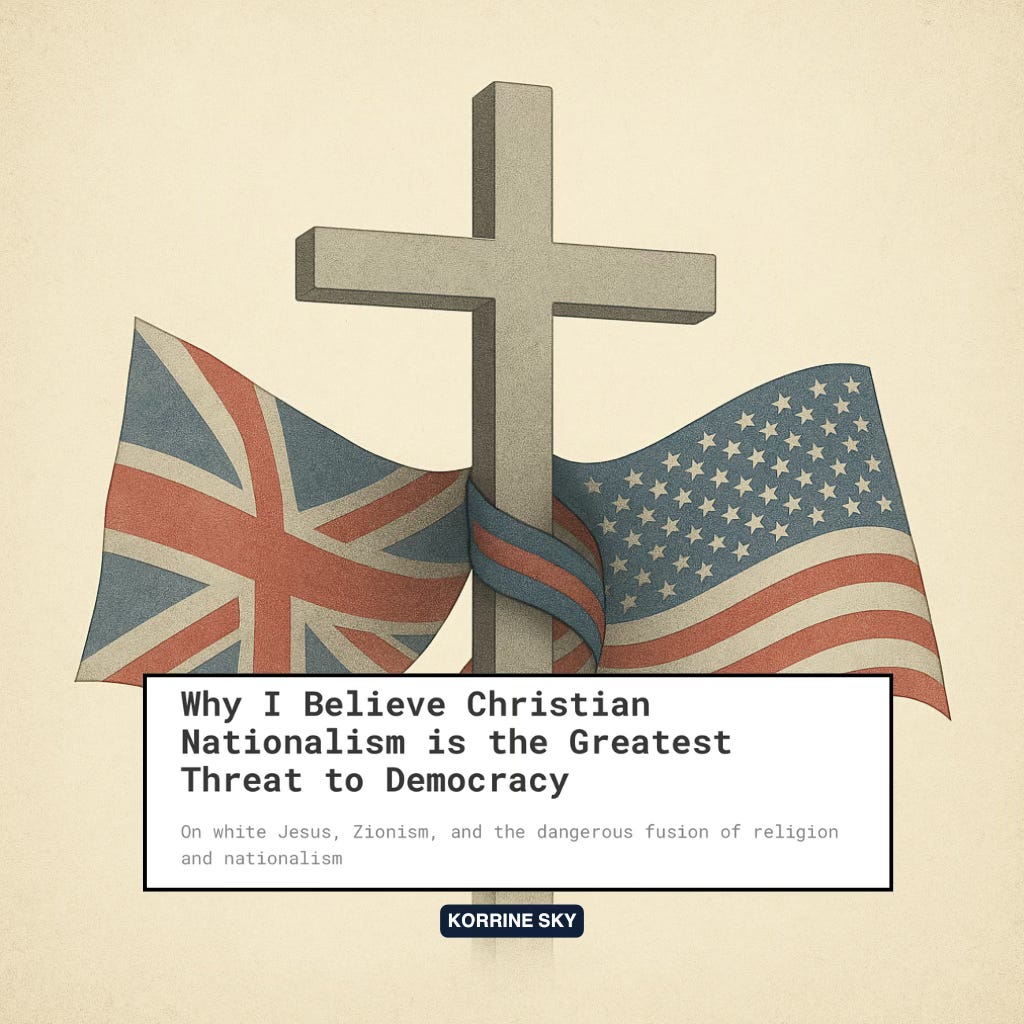
Why I Believe Christian Nationalism is the Greatest Threat to Democracy
Korrine Sky · September 2025 · 5 min read
This is not a neutral essay. I am writing as someone who has watched the far right march through London, seen Christian nationalism exported from America, and studied how faith has been weaponised for centuries. What fol
Listen to this essay
Narrated version
This is not a neutral essay. I am writing as someone who has watched the far right march through London, seen Christian nationalism exported from America, and studied how faith has been weaponised for centuries. What follows is not “both sides.” It is my view of how dangerous these currents are, and why we should be alarmed.
On 13 September 2025, thousands of far-right demonstrators marched through London, rallying behind convicted agitator Tommy Robinson under banners of “defending Christianity” and “protecting the nation.” Hours later, across the Atlantic, Charlie Kirk, founder of Turning Point USA and one of the most recognisable faces of Christian nationalism, was assassinated while addressing students in Utah. Two moments, continents apart, yet connected by a common thread: the weaponisation of religion to build political power.
But to understand the danger, we must first name it. Christian nationalism is not the same as Christianity. It is the belief that the state should be explicitly Christian, that national identity should be fused with religious identity, and that those who do not belong, including Muslims, Jews, migrants, secularists, and Black and brown communities, are outsiders. It is less about theology and more about power: who belongs, who governs, who is protected, and who is excluded.
A History of Christian Nationalism
History gives us stark warnings. In the United States, the Ku Klux Klan marched in white robes beneath burning crosses, presenting themselves as defenders of “Christian civilisation.” Their terrorism was sanctified in biblical language, and their violence was justified as protection of a white Christian order. In Nazi Germany, the regime fused nationalism with a distorted theology known as “Positive Christianity,” replacing the universal Christ with an Aryan one. Churches were co-opted, scripture was rewritten, and millions were persecuted in the name of a Christianised national project.
And beneath all of this lies a more subtle but equally potent force: the image of Jesus himself.
The Making of a White Jesus
The now-familiar European “white Jesus,” blue-eyed, fair-skinned, with soft European features, was not how the earliest Christians imagined Christ. In the first centuries of Christian art in North Africa and the Middle East, Jesus was depicted with darker, Semitic features, closer to his historical context.
The shift began with the European Renaissance in the 14th to 16th centuries. Painters like Leonardo da Vinci (The Last Supper) and Michelangelo (The Last Judgment) recast Christ in their own image: Italian, pale-skinned, with flowing hair. This was not merely artistic preference. It was Europe remaking the divine in its likeness at the very moment it was embarking on empire.
By the 16th and 17th centuries, as European powers colonised Africa, the Americas, and Asia, the white Jesus travelled with them. Missionaries carried paintings and statues of a pale European Christ into colonised lands, teaching enslaved and conquered peoples that salvation looked like their oppressors. As Black theologian James Cone later argued, this image made whiteness itself appear sacred, while turning Blackness into a mark of sin or servitude.
In the United States, the image was further entrenched in the 19th century. Joseph Smith, the founder of Mormonism, described visions of a fair-skinned, light-haired Christ, reinforcing the racial hierarchies already built into American life. By the early 20th century, the white Jesus was everywhere: in Sunday school books, stained-glass windows, and Hollywood films. When the Ku Klux Klan lit crosses and terrorised Black communities, they did so under the gaze of a white Christ, convinced they were defending “Christian civilisation.”
The white Jesus was never just a painting. It was propaganda, a cultural anchor for empire, slavery, segregation, and white supremacy. It racialised divinity itself, embedding the idea that to be holy, powerful, or fully human was to be white.
The Present Echoes
We are witnessing echoes of this now. Thousands in London marched under the guise of “heritage” and “faith,” but what we really saw was the cross brandished as a shield for bigotry. The presence of American figures like Kirk shows how these movements are globalising. Britain is not just importing US fast food and films; it is also importing their culture wars, complete with Christian nationalist rhetoric.
And the parallels are not confined to the West. Zionism, in its political form, represents another fusion of religion and nationalism. The claim to an ethno-religious state has justified the ongoing dispossession of Palestinians, the building of an apartheid system, and today, a genocide that has killed hundreds of thousands. This is not a metaphor. It is the deadly reality of what happens when faith is conscripted into a nationalist project. Just as Christian nationalism recasts Christianity as a project of white domination, Zionism recasts Judaism as a project of territorial control. In both cases, religion becomes the handmaiden of exclusionary power.
A Global Pattern
This is not just a British or American story. In Brazil, Jair Bolsonaro cloaked his authoritarianism in Pentecostal revivalism. In Hungary, Viktor Orbán uses Christian language to prop up an illiberal regime. In India, Hindu nationalism mirrors the same logic: religion fused with state to justify exclusion and persecution. These are not isolated stories, but a shared global strategy.
And yet, leadership has too often been silent or complicit. Donald Trump built his political base on the backing of white evangelicals and refused to condemn Christian nationalist violence. Benjamin Netanyahu invokes divine mandate to justify occupation and settlement expansion, while presiding over policies described by human rights groups as apartheid. Even in Britain, Keir Starmer has avoided direct condemnation of far-right marches, preferring vague statements about law and order rather than addressing the toxic ideologies that drive them. Their failures show how mainstream leaders, by silence or appeasement, allow extremism to take root.
The Danger of Crisis Politics
The danger is clearest in moments of crisis. In times of economic anxiety, cultural insecurity, and political distrust, scapegoating becomes seductive. Robinson, Kirk, and their allies know this. Their strategy is not only about rallies. It is about planting seeds in pulpits, on campuses, and online that turn discontent into a war against Muslims, migrants, and multiculturalism.
We must be clear: marching for Tommy Robinson is not about free speech or Christian identity. It is about mainstreaming extremism. It is about building an ecosystem where nationalism masquerades as faith, and where imported ideologies reshape domestic politics.
Reclaiming Faith, Reclaiming Belonging
The response cannot be limited to condemning violence after the fact. It must reclaim the narratives of faith and belonging themselves. Christianity has never belonged to the far right. Judaism has never belonged to Zionism. Faith cannot be ceded to those who weaponise it.
If we fail to challenge this nexus between faith and fascism, we risk sleepwalking into futures we already know too well: lynchings sanctified by crosses, regimes baptised in blood, and insurrections justified as divine will. January 6th in Washington was one warning. London’s march is another.
The lesson of history is clear: when religion is captured by nationalism, democracy does not simply weaken, it unravels. Each of us has a choice: to look away, or to confront the lies that sanctify violence in God’s name.
Culture & Commerce is a reader-supported publication. To receive new posts and support my work, consider becoming a free or paid subscriber.
Culture & Commerce
Get the next essay first.
Culture, brand power and influence, read straight from my desk. No spam, unsubscribe anytime.
Prefer Substack? Follow Culture & Commerce there.
Originally published in Culture & Commerce. Read the original post.