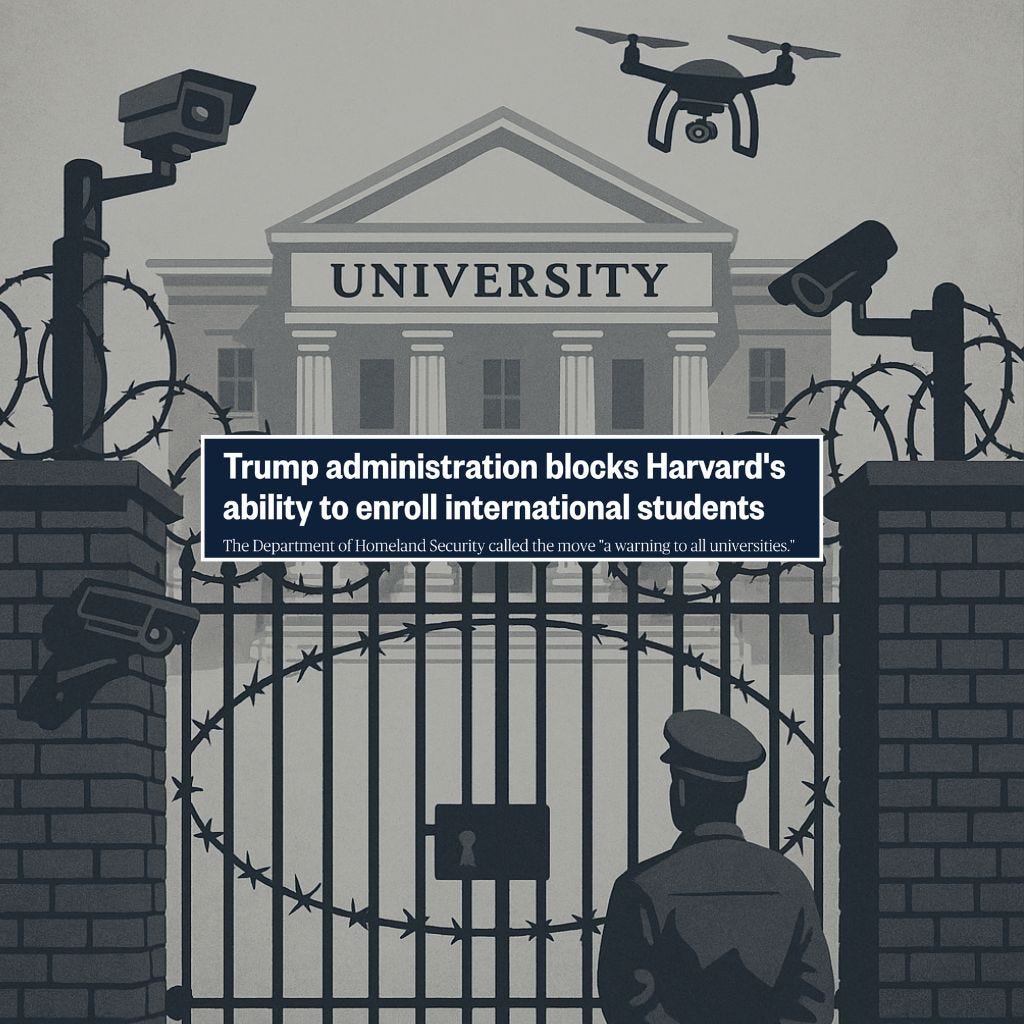
What happens when the most prestigious university in the world becomes a testing ground for ideological compliance?When immigration law is used to silence protest?When dissent is rebranded as extremism?
Listen to this essay
Narrated version
What happens when the most prestigious university in the world becomes a testing ground for ideological compliance?When immigration law is used to silence protest?When dissent is rebranded as extremism?
This is bigger than Harvard.It reveals a system where protest is punished, free speech is filtered through citizenship, and education is being reshaped to serve power — not question it.
The Retaliation
Harvard has been blocked from enrolling international students.Over 6,700 students — from more than 140 countries — now face an impossible choice:Leave. Transfer. Or risk losing everything.
Why?Because the Trump administration demanded surveillance footage, immigration records, and disciplinary files tied to Gaza solidarity protests.Harvard refused. So the state retaliated, by targeting the most legally vulnerable members of its community.
Let’s be clear:This had nothing to do with campus safety.It was a coordinated attempt to punish Harvard for refusing to comply with a political ultimatum.
The Trump administration accused the university of:
- Fostering antisemitism
- Promoting “pro-Hamas” sentiment
- Creating a hostile environment for Jewish students
- Enabling “anti-American agitators”
- Even alleging collaboration with the Chinese Communist Party
But beneath the inflammatory rhetoric is a strategic agenda:Force universities to suppress political dissent, dismantle DEI, and surrender control over what students can think, say, or protest.
Harvard was told to:
- Expel student protestors
- Turn over immigration and disciplinary records
- Submit to a “viewpoint diversity” audit
- Abandon divestment demands and equity policies
Harvard refused.
In response, the administration revoked its ability to enrol international students — a move legal scholars have called unconstitutional.Harvard is now suing the Trump administration, arguing that the government is using immigration law as a political weapon and violating the university’s academic freedom under the U.S. Constitution.
This wasn’t a policy dispute.It was political retribution.And international students were made collateral.
Why Go After the Thinkers?
“You've got a wonderful kid who's done very, very well and then you send them to Harvard and the kid comes home and you don't even recognise them...They’re definitely primed to be a fabulous left-wing activist but they’re maybe not going to be able to get a job.”— Tammy Bruce, U.S. State Department spokesperson
This isn’t just a flippant soundbite.It’s a worldview.
One where education is acceptable as long as it doesn’t transform you.Where universities are expected to sharpen your résumé — not your politics.Where critical thinking is treated as a threat, not a skill.And where being “unrecognisable” to your parents is framed as failure, not growth.
But what Bruce is really saying is this:Don’t send your kids to learn — send them to be reproduced.
She’s not concerned about employability.She’s concerned about loyalty.And she’s not alone.
Because the state doesn’t want critical citizens.It wants compliant graduates… the kind who can pass the corporate background check, but not the mirror test of moral responsibility.
The Legacy of Student Resistance
Education was never meant to be about compliance.Its purpose is to challenge systems — not protect them.To expand political imagination — not narrow it to what’s safe.To make us better citizens — not quieter ones.And that’s what makes education dangerous.
Because education is not a reward for obedience.It is a human right, not a privilege to be revoked when students become politically inconvenient.When access to learning is tied to ideological loyalty, we’re no longer talking about education.We’re talking about control.
Universities should not just teach — they should seed resistance.
- In Zimbabwe, student uprisings in 1988 dared to confront the states regime.
- In South Africa, the 1976 Soweto youth uprising helped unravel apartheid.
- In Egypt, student-led protests fuelled the 2011 Arab Spring.
- In Hong Kong, class boycotts became mass movements for democratic rights.
- And across the United States today, Gaza solidarity encampments are showing that campuses remain sites of defiance, legacy, and unfinished struggle.
International students carry that legacy across borders.They bring political insight, historical memory, and cultural fluencyjust like we did with #AfricansInUkraine, when the war exposed how Black bodies are last to be saved, first to be displaced.
But here's what many don’t see:
In interviews about this crisis, international students hesitated to speak… because they were afraid.
Afraid that speaking up could jeopardise their immigration status.Afraid their families’ sacrifices would be wasted.Afraid of being punished for simply having an opinion.
Because many international students live with a quiet, constant pressure:Gratitude over grievance. Silence over solidarity.
They pay more.They carry the weight of being "the lucky ones."And not all come from wealth.For some, this education represents their parents' entire life savings or the only shot their family has to break generational cycles.
So when they stay quiet, it’s not apathy.It’s survival.
When governments exploit that silence, they reduce international students to conditional participants — not full members of the academic community. Their presence becomes provisional. Their right to stay, speak, or even graduate is tied to how quiet they remain.
The Harvard Contradiction
Harvard is one of the most powerful private universities in the world.It has wealth, prestige, and global reach.
But even within those walls if you are foreign, racialised, or politically inconvenient —you are still disposable.
White supremacy strips people of the protection capitalism promises them.It creates a caste system inside even the most elite institutions —where citizenship becomes a shield, and everything else is a strike against you.
So when the Trump administration targets international students, it’s not just about immigration law.It’s a global message:Your knowledge is welcome — but your politics are not.
By branding them as dangerous, the state reframes international students as ideological contaminants —bad apples here to spoil the batch.
But here’s the truth:Not all protestors were international.And not all international students protested.Yet all are being punished — because punishment is the point.
We are not free until all of us are free.And if even Harvard can’t shield its students from this —What protection is left for the rest of us?
The University as Surveillance Site
This goes deeper than censorship.It’s the transformation of academia into an extension of state power —where immigration enforcement, intelligence gathering, and ideological control converge on campus.
The Trump administration demanded:
- 5 years of protest footage
- Immigration records for all international students
- Files on “dangerous speech” by non-citizens
When Harvard refused to comply, its visa authority was revoked.Thousands of students were left in legal limbo — not for what they did,but for who they are and what they might represent.
But this didn’t start here.
Last year:
- 13 students at Harvard were barred from graduating for joining a Gaza solidarity encampment — even after completing all academic requirements
- Columbia University called in riot police
- Students across the country were expelled, arrested, and doxxed
- “Viewpoint audits” and funding threats became tools of ideological control
This isn’t about protecting campuses.It’s about disciplining thought through visibility —and punishing those who make power uncomfortable.
The university is no longer a sanctuary for learning.It’s becoming a stage for compliance theatre — where refusing to perform comes with real consequences.
The Global Cost
When the world’s most powerful university is told to submit or be stripped of its students, it sends a warning to every institution:Conform, or be cut off. Align, or be gutted.
And if international students (the most surveilled, scrutinised, and politically vulnerable) can be erased this easily?
Then what does that say about freedom?About inquiry?About who is allowed to think and who is only allowed to comply?
Let’s name it for what it is:Ideological purification through policy.Literal brainwashing by way of visa threats and state surveillance.A creeping form of academic fascism, dressed up as campus security.
And the damage doesn’t end at U.S. borders.
This kind of crackdown deepens the global brain drain.It tells the next generation of leaders, scientists, organisers, and cultural workers from the Global South:
You can study here — but don’t bring your politics with you.
It extracts brilliance and punishes boldness.It imports talent but deports resistance.And in doing so, it strips home countries of the very people most equipped to lead change.
But here’s the deeper violence:Most people — especially marginalised people — can’t afford to be apolitical.Our identities are already politicised.Our lives are shaped by the systems we’re told to stay silent about.
To demand neutrality from the oppressed is to ask them to deny their own survival.And when the price of education is silence… that’s not a scholarship. It’s submission.
Because when you send your best minds abroadonly to have them criminalised, silenced, or returned with nothing but fearit’s not only a personal loss.It’s geopolitical strategy cloaked in visa language.
This isn’t education.It’s control.
If you build culture, this should terrify you.
Because it’s not just students being policed.It’s anyone with reach, voice, or influence.
Brands, media, artists, strategists — we’re all on notice.
When borders are weaponised against ideas,When protest is rebranded as extremism,When dissent is punishable by deportation
It’s not education they’re afraid of.It’s imagination.
What do you think?
What should universities do in times of political crisis?Are international students being scapegoated — or strategically erased?And how should cultural leaders respond when free thought becomes a border issue?
About the Author
I'm Korrine Sky — cultural strategist, writer, and Editor-at-Large at The Southern African Times. Through Culture & Commerce, I explore how power shows up in language, branding, protest, and platforms — and what it means to build influence without erasure.
This essay is part of my ongoing effort to document and disrupt how control is disguised as care — in institutions, in marketing, and in culture.
If you believe storytelling is political — stay with me.
🔁 Share this piece if it resonates.📬 Subscribe for more essays at the intersection of identity, protest, and cultural power.📲 Connect with me on LinkedIn or Instagram to keep the conversation going.
Subscribe now
Culture & Commerce
Get the next essay first.
Culture, brand power and influence, read straight from my desk. No spam, unsubscribe anytime.
Prefer Substack? Follow Culture & Commerce there.
Originally published in Culture & Commerce. Read the original post.