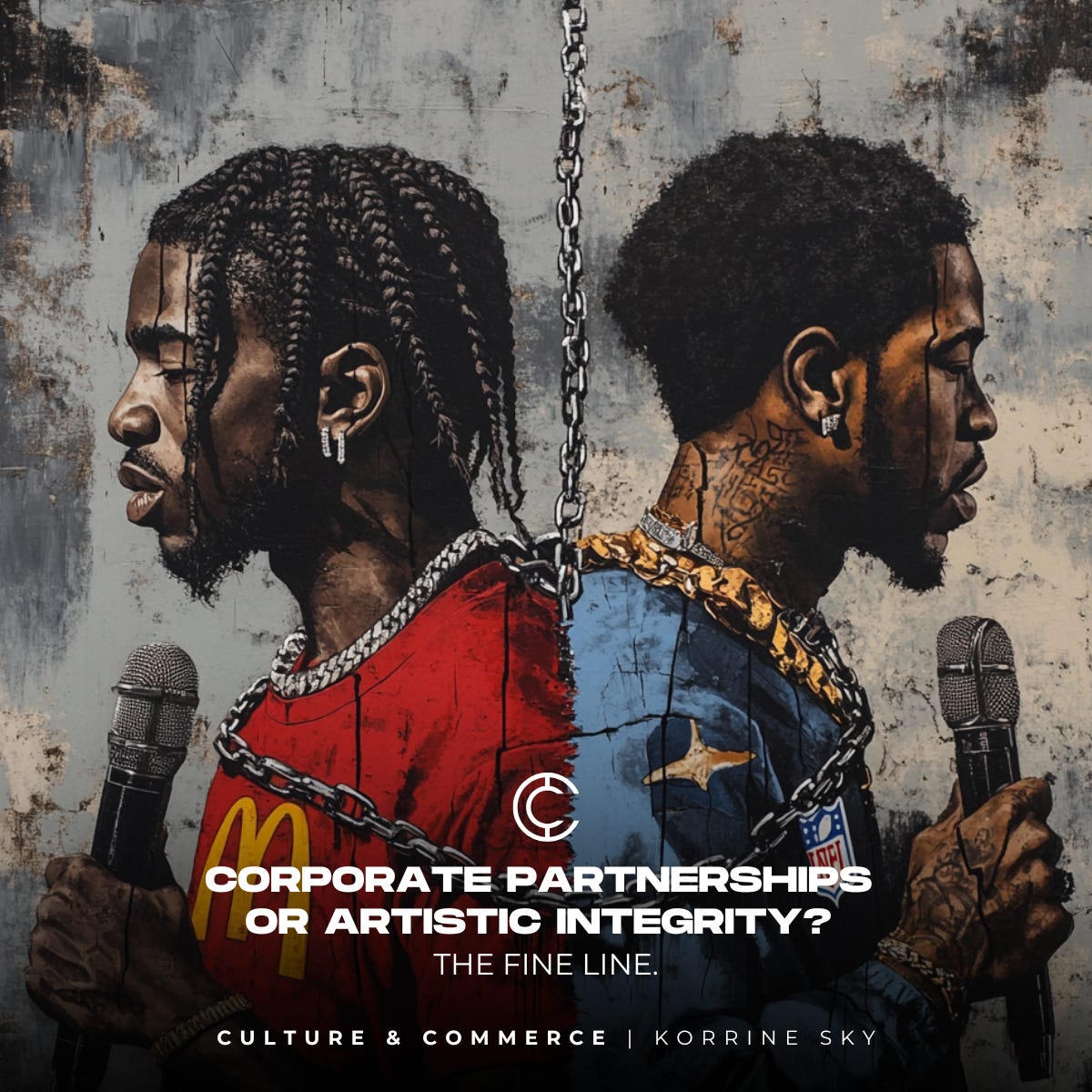
The Business of Influence: Stormzy, Kendrick & The Double Standards of Corporate Activism
Korrine Sky · February 2025 · 5 min read
There is a moment every artist faces, the tension between activism and capitalism, influence and endorsement, power and profit.
Listen to this essay
Narrated version
There is a moment every artist faces, the tension between activism and capitalism, influence and endorsement, power and profit.
Stormzy and Kendrick Lamar have built careers on standing for something. They are not only musicians, they are cultural leaders, activists, and storytellers. Both have spoken out about racial justice, systemic inequality, and corporate exploitation.
Yet both have also partnered with major corporations whose values and business practices seemingly contradict their messages.
🔥 Stormzy’s McDonald's partnership was met with widespread backlash.🔥 Kendrick Lamar’s Apple/NFL Super Bowl performance was widely praised.
Why?
Why did Stormzy’s McDonald’s deal trigger accusations of selling out, while Kendrick’s Super Bowl performance (sponsored by two companies with deeply problematic histories) was viewed as an artistic triumph?
- Is this a question of geography? Are UK audiences more cynical than US audiences?
- Is it about how Black celebrities are allowed to operate in American versus British media?
- Or is it about the structure of the deals themselves, one being a clear commercial advert, the other a performance that disguised its corporate sponsorship?
To truly understand this, we need to break down the power dynamics at play.
🤝 Can Activism and Corporate Sponsorship Coexist?
Stormzy’s and Kendrick’s brand partnerships reveal a fundamental tension between activism and capitalism.
⚡ On one hand, artists are expected to use their platforms to uplift their communities, challenge oppression, and stand firm in their values.⚡ On the other, they exist within a capitalist system where success is often tied to corporate sponsorships, partnerships, and endorsements.
But when does a corporate collaboration become a contradiction? And when is it simply a necessary part of playing the game?
To answer that, let’s look at who Stormzy, McDonald's, Kendrick, Apple, and the NFL are actually serving.
🍔 Case Study 1: McDonald's & Stormzy – Fast Food Meets Conscious Rap
McDonald's is in crisis mode.
Following global boycotts over its Israeli franchisee’s free meal donations to Israeli soldiers, McDonald's has been hit with one of its biggest financial slumps in recent years.
📉 The Financial Impact of Boycotts
- McDonald's suffered its first sales decline in four years, with an estimated $7 billion in losses tied to the backlash.
- Gen Z and younger consumers are increasingly rejecting brands that are perceived as unethical.
McDonald’s needs to rehabilitate its image and how do you fix a PR disaster? Cultural capital.
🎤 Why Stormzy?
Stormzy is one of the UK’s most beloved cultural figures, not only a rapper, but a symbol of integrity, activism, and leadership.
✅ Pro-Black, pro-community ethos✅ Mainstream appeal beyond music✅ Seen as an activist and positive role model
For McDonald's, this is a strategic opportunity to regain trust among Gen Z, millennials, and Black and minority consumers.
👉 If Stormzy is eating McDonald’s, how bad can it really be?
💥 Why This Backfired
The backlash against Stormzy was swift and unforgiving. Why?
1️⃣ Health Contradiction – Stormzy is known for promoting fitness and discipline, but McDonald’s is synonymous with fast food and unhealthy eating habits.2️⃣ Political Contradiction – Stormzy has publicly supported Palestine, yet partnered with one of the most visible brands in the Israel-Palestine boycott movement.3️⃣ British Cynicism – The UK is far more sceptical of celebrity endorsements. Unlike in the US, there is no "celebrity-industrial complex" that shields artists from scrutiny.
📢 Stormzy's Response
📝 “My stance on Palestine has not changed.”📝 “The brands I work with can’t tell me what to do.”📝 “I understand why people feel disappointed, but I haven’t compromised my beliefs for money.”
This did little to sway public opinion. For many, the damage was already done.
🏈 Case Study 2: Kendrick Lamar, Apple & The NFL – A Carefully Curated Protest?
Kendrick Lamar’s Super Bowl performance was hailed as a powerful artistic statement, blending racial symbolism, corporate-funded protest, and social commentary on one of the biggest stages in the world.
Yet, this performance was sponsored by two institutions deeply entrenched in exploitation and systemic oppression: Apple and the NFL.
🏢 The NFL: A League Profiting from Black Talent While Silencing Black Voices
The NFL has a long history of racism and hypocrisy.
🚨 Colin Kaepernick was effectively blackballed from the league after kneeling in protest against police brutality.🚨 Despite 53.5% of NFL players being Black, team ownership and executive leadership remain overwhelmingly white—with only one Black majority owner in the league’s history.🚨 The league’s past concussion cover-ups disproportionately impacted Black players, raising questions about player safety and exploitation.
Even the Rooney Rule, which was meant to encourage diverse hiring practices, has been largely exposed as performative, with many Black coaches still struggling to get leadership roles.
👉 By platforming Kendrick Lamar, the NFL profits from the appearance of racial justice while maintaining the very structures that suppress Black athletes and executives.
🍏 Apple’s Exploitation of Black Labour & the Global South
While Apple presents itself as a progressive, innovation-driven company, its supply chain is deeply linked to human rights abuses in the Congo.
🚨 Apple has been accused of using conflict minerals sourced from war-torn areas of the Democratic Republic of Congo.🚨 The tin, tantalum, tungsten, and gold used in Apple products are often extracted under conditions of forced labour and militia-controlled mines.🚨 The Congolese government has filed legal complaints against Apple in France and Belgium, accusing the company of complicity in crimes committed by armed groups.
Despite these allegations, Apple continues to align itself with Black artistry, particularly in hip-hop, to maintain cultural relevance.
💡 So while Kendrick Lamar’s Super Bowl performance was packed with powerful anti-capitalist and anti-racist symbolism, was it actually challenging power, or was it merely reinforcing Apple’s dominance in Black culture?
⚖️ Why Was Kendrick Praised & Stormzy Bashed?
Both Kendrick and Stormzy partnered with controversial corporations.But one was framed as an artistic statement, the other as a commercial endorsement.
🔍 Key Differences
🟢 Stormzy’s McDonald’s deal was seen as purely transactional.🟢 Kendrick Lamar’s Super Bowl performance was framed as a powerful artistic statement.
So, what made the difference?
1️⃣ Type of Partnership – Stormzy’s McDonald’s deal was a direct advert. Kendrick’s performance felt like artistic expression.2️⃣ Who Pays Who? – Stormzy was paid by McDonald’s. The NFL does not pay artists to perform at the Super Bowl.3️⃣ Public Image & Expectations – Stormzy is seen as grassroots. Kendrick is seen as a revolutionary artist.
🎭 The Final Question: Do We Care Enough to Change How We Spend?
⚡ Stormzy won’t be "cancelled."⚡ McDonald's, Apple & The NFL will be fine.⚡ Most consumers will move on.
But if we want ethical consumerism, do we need to focus less on celebrities and more on our own spending habits?
Share
Share Culture & Commerce
📩 Join Culture & Commerce for more deep dives into branding, influence, and consumer behaviour.
Culture & Commerce
Get the next essay first.
Culture, brand power and influence, read straight from my desk. No spam, unsubscribe anytime.
Prefer Substack? Follow Culture & Commerce there.
Originally published in Culture & Commerce. Read the original post.