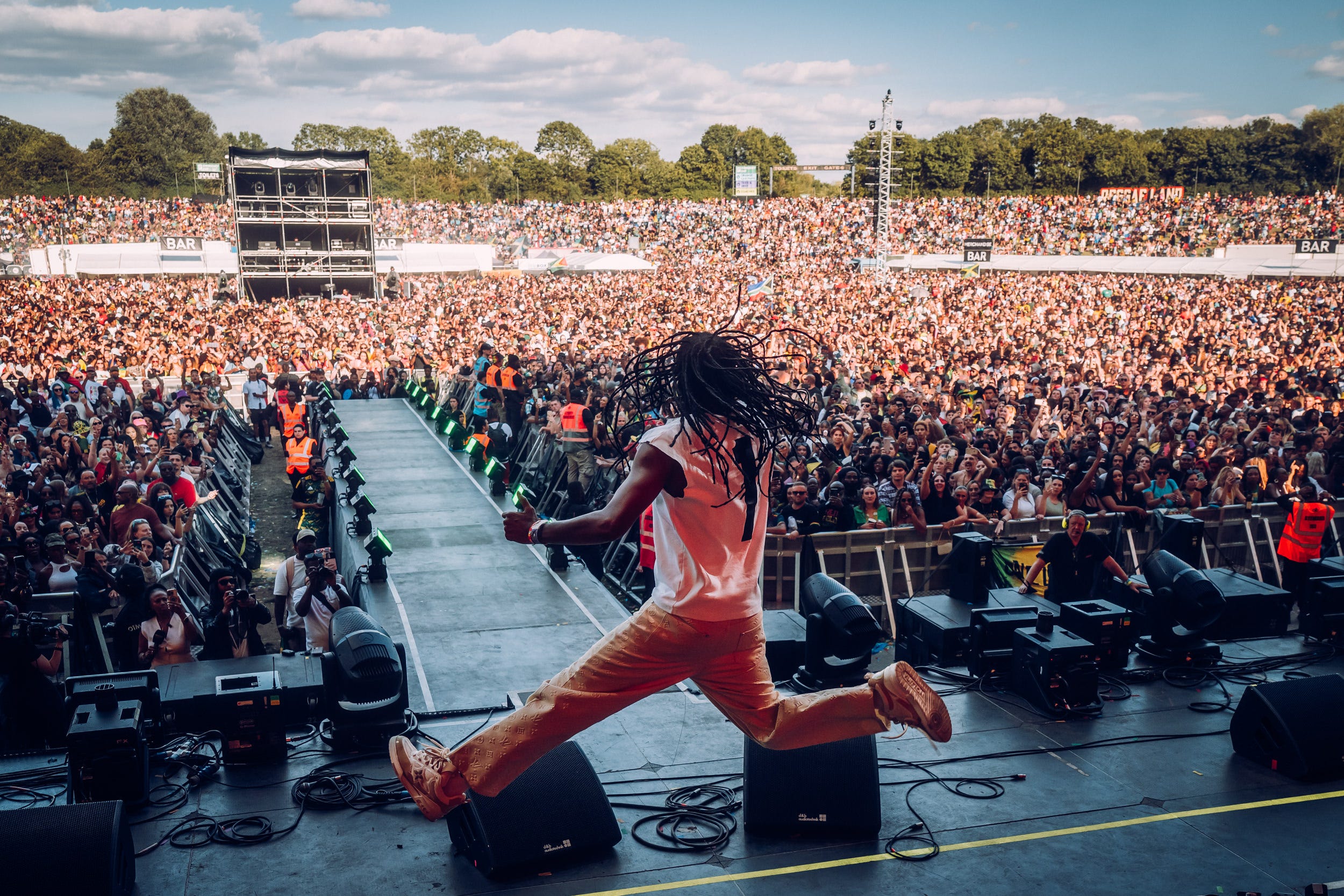
We're all Africans, until an African headlines Reggae Land
Korrine Sky · August 2026 · 14 min read
On reggae, ownership, and why Black unity gets complicated the moment power enters the room.
Listen to this essay
Narrated version
When Burna Boy was announced as the headliner for Reggae Land’s newly added Friday, the objection arrived almost immediately.
He is not a reggae artist. He makes Afrobeats. Why is a Nigerian headlining a festival built around Jamaican music?
Solidarity is easy to declare and expensive to practise. The bill arrives when someone has to give up the headline slot.
Burna eventually addressed it from the stage. Music, he said, is universal, a language understood regardless of race or origin. Genres like Afrobeats and reggae may help us describe music, but they shouldn’t restrict how we experience it.
It’s an appealing argument. It’s also the kind that gets less convincing once power enters the room.
Music can be universal while ownership remains radically unequal.
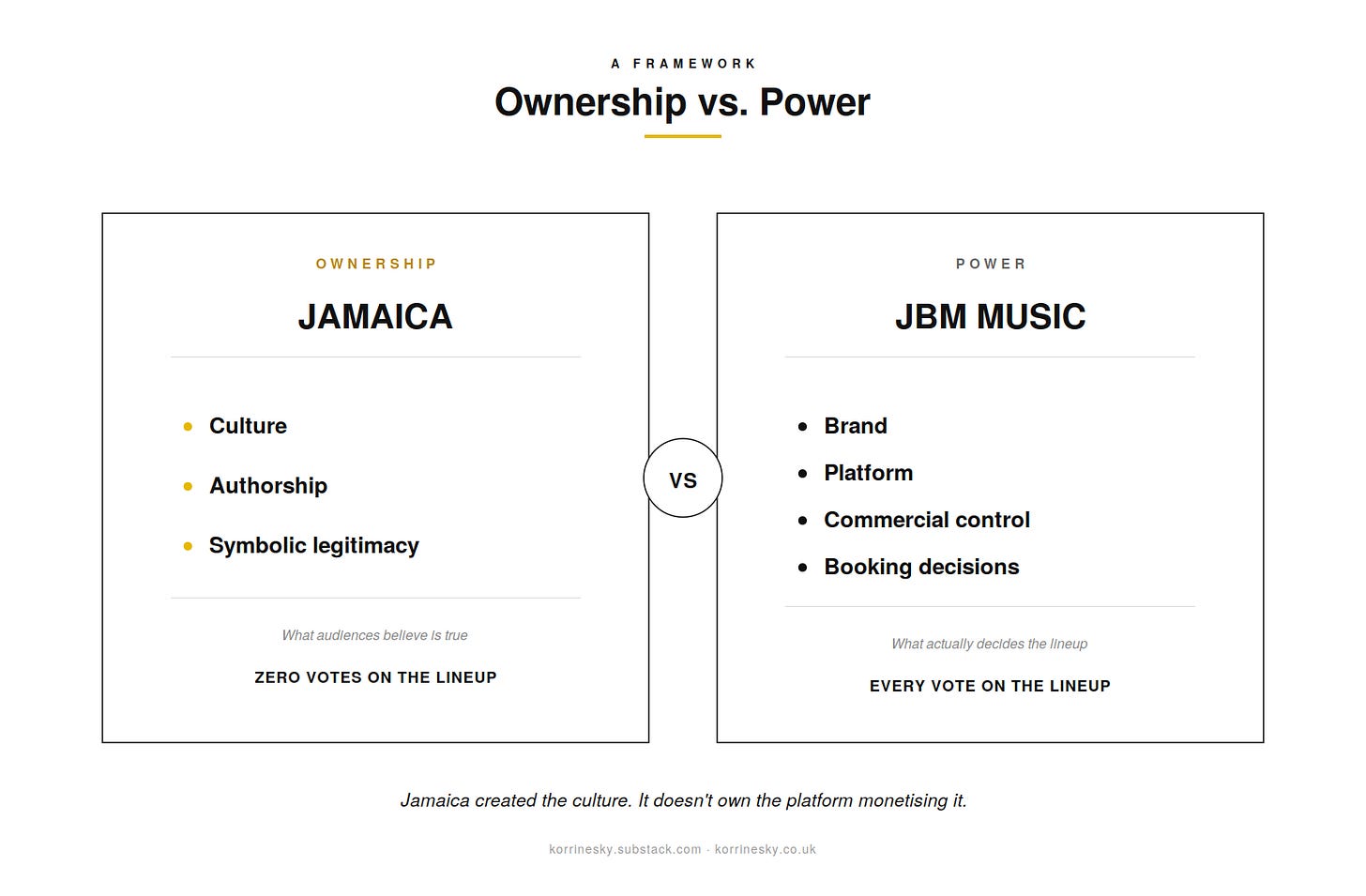
A sound can travel everywhere while the people who created it retain little control over the festivals and institutions built in its name. Culture is universal. Institutions rarely are. That gap splits into four separate questions people keep collapsing into one: who created the music, who owns the platform it’s performed on, who profits from it, and who audiences believe has the authority to decide what it means. Genre is just the vocabulary people reach for when they don’t have a better one for asking who profits.
So the more interesting question isn’t whether Burna deserved to headline. It’s why Reggae Land’s boundaries suddenly hardened around him, because Reggae Land was never a genre-pure reggae festival.
Its 2026 lineup tells the story on its own. Burna Boy opened the newly added Friday. Beenie Man and Morgan Heritage headlined Saturday under a joint billing called The King & The Royals. Vybz Kartel headlined Sunday, joined by Shenseea and Shaggy. Across the weekend’s seven stages sat Konshens, Kranium, T.O.K, Charly Black, Cham, Serani and Ding Dong, with an entire stage called, simply, the Dancehall Stage.
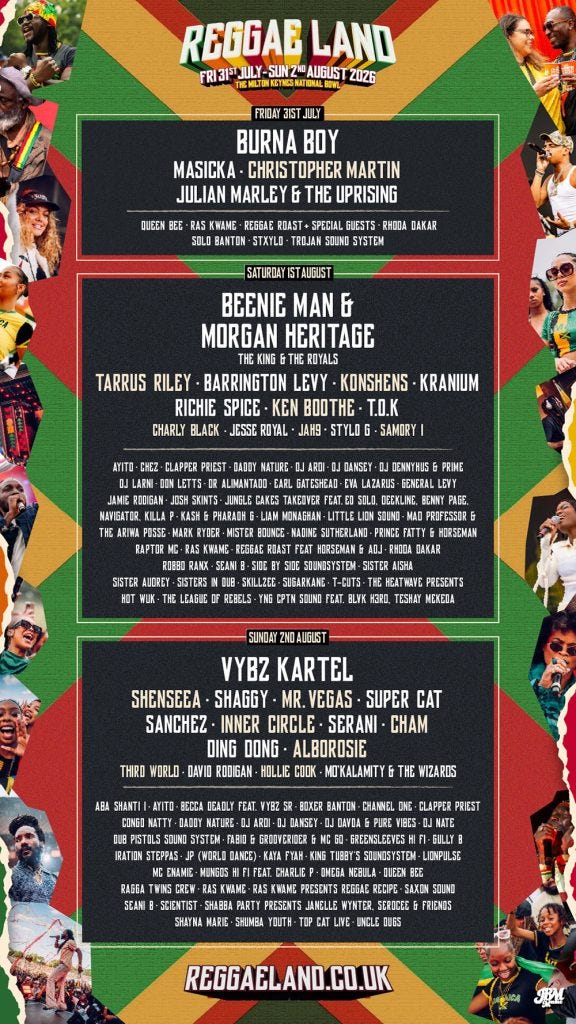
Vybz Kartel is not primarily a reggae artist. Neither is Shenseea, nor Beenie Man. They are dancehall artists, and nobody requires that distinction to be defended, because Reggae Land already established that dancehall belongs inside the territory its name represents.
So “Burna Boy isn’t reggae” cannot be the conclusion. It barely survives as the opening premise.
A festival that outgrew its own name
Part of the confusion is a branding problem, not just a cultural one.
Reggae Land’s programme has moved a long way from what its name promises. What it actually books now, dancehall, dub, ska, jungle, carnival sound systems, British hybrids and increasingly Afro-fusion, is closer to a Jamaican music and sound-system festival than a reggae festival in any narrow sense. The product evolved. The name didn’t.
Imagine the reverse case. Imagine Afro Nation rebranded itself Afrobeats Nation and then kept booking Amapiano, hip hop and dancehall acts anyway. The mismatch would be obvious immediately, and people would ask exactly the question Reggae Land’s audience is now asking: what does this name actually promise us, and did we sign up for something narrower than what we got?
That gap between brand and product is where the backlash lives. The festival knew it was building a broad Jamaican-music ecosystem. Part of its audience still believed they were buying a reggae-specific, and by extension Jamaica-specific, cultural space. Burna Boy didn’t create that gap. He walked into it.
Four kinds of ownership, one argument
The framework from the opening is worth unpacking properly.
There is cultural authorship: who created the music. That’s Jamaica, without dispute.
There is institutional ownership: who owns the festival, the brand, the licence to use the name.
There is commercial ownership: who profits from ticket sales, sponsorship and the festival’s growth.
And there is symbolic ownership: who audiences believe has the authority to decide what the culture means and who represents it. That’s still Jamaicans, at least in most fans’ minds, even though they hold none of the other three.
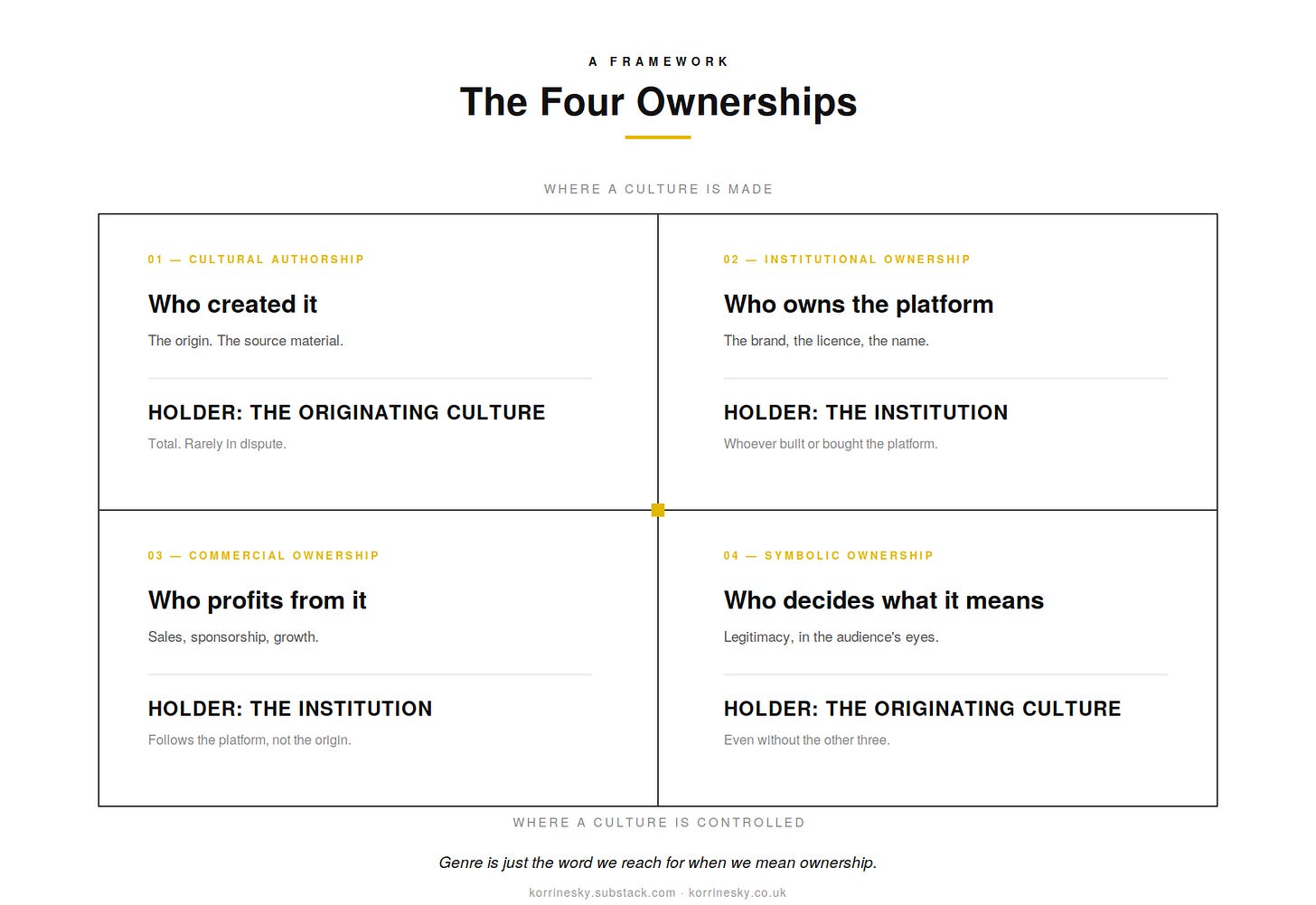
Jamaica has total cultural authorship and near-total symbolic ownership, and almost no institutional or commercial ownership of the platform built on top of its own music. That gap is the actual subject of every version of this argument, whether it’s phrased as “he isn’t reggae” or “protect the culture” or “music is universal.”
Which raises the harder question underneath all of it: can you still own a culture you no longer control? Jamaica authored reggae and dancehall. It doesn’t follow that Jamaica gets to determine who headlines a British-owned festival using that music, how it’s branded, how it’s sold, or how it evolves. If authorship doesn’t come with control, what is ownership actually doing for the people who have it.
Can you still own a culture you no longer control?
We celebrate unity until the issue is billing
This same suspicion shows up every year at Notting Hill Carnival, and anyone who has spent time around live African and Caribbean music in Britain will have watched it happen more than once. African attendees bring flags, DJs, fashion, increasingly visible participation. Some Caribbean voices respond that carnival was built through Caribbean resistance and labour in Britain and shouldn’t be blurred into a generic celebration of Blackness. Some African voices argue carnival has become one of Britain’s largest expressions of diasporic Black culture, and their presence is a natural extension of that.
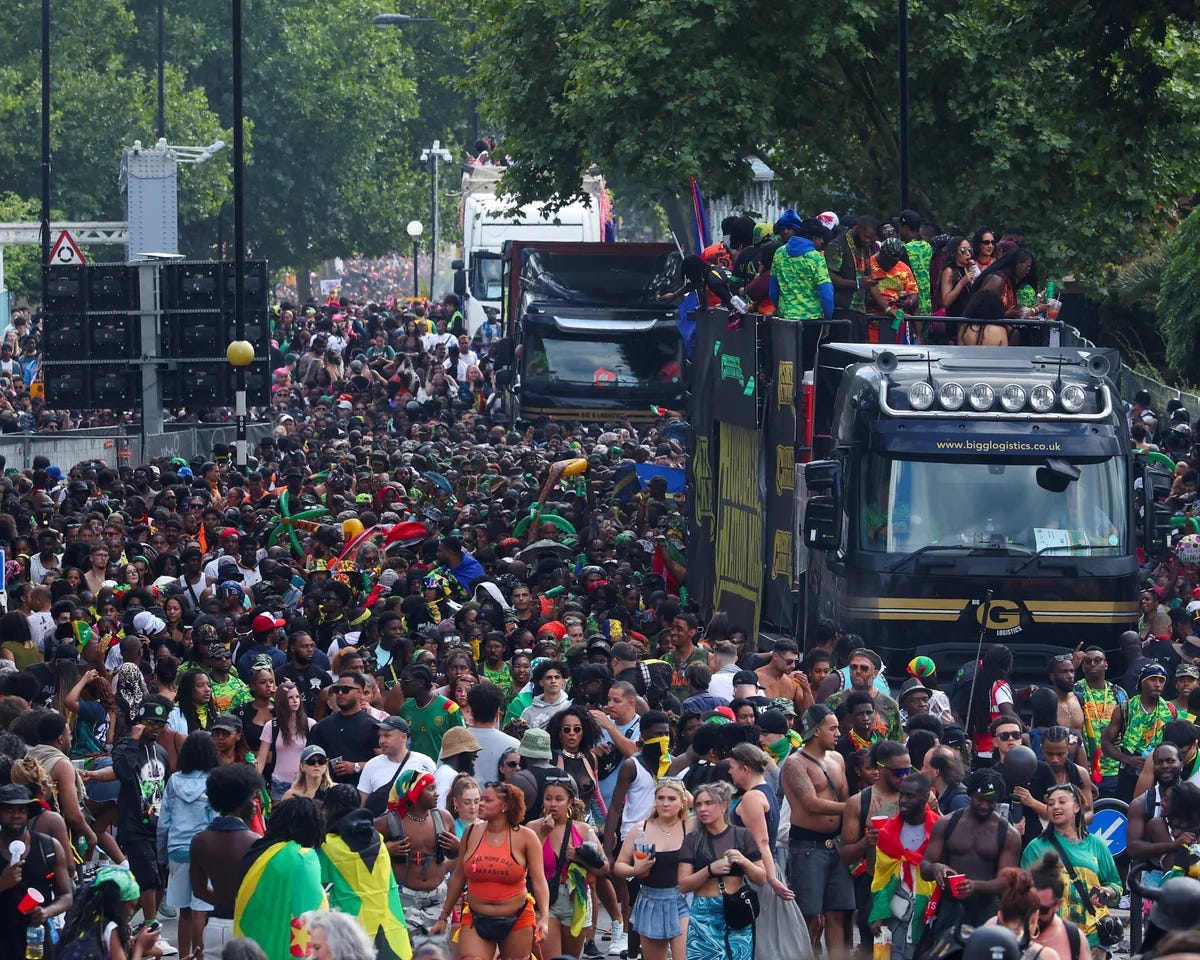
Both positions hold some truth. The conflict starts when shared Blackness is used to erase who built the institution, or when a legitimate claim to origin is used to deny all later participation. We agree we’re connected until the issue is who gets the stage.
The Burna Boy debate belongs to that same family. It isn’t simply reggae fans versus Afrobeats fans. It’s a dispute over whether African participation represents kinship, intrusion, or commercial takeover, and who gets to decide. Reggae Land’s own structure, a British-owned company stretching a Jamaican name across ska, jungle, dub and naturalised white performers like Hollie Cook or Prince Fatty, already shows that belonging here has never been a strictly musical question. It’s been about who’s recognised as a participant versus who’s treated as a visitor.
Dancehall is the missing bridge
Part of the confusion comes from treating this as a straight binary, reggae or Afrobeats, which erases the history connecting them.
Jamaican music didn’t develop into reggae and stop. Ska gave way to rocksteady, reggae expanded into roots and dub, and sound-system culture kept organising music through selectors, deejays and riddims. Dancehall emerged from that world and increasingly reflected digital production, street language and urban Jamaican life, a different social register from roots reggae’s Rastafari, liberation and repatriation, but not a lesser one.
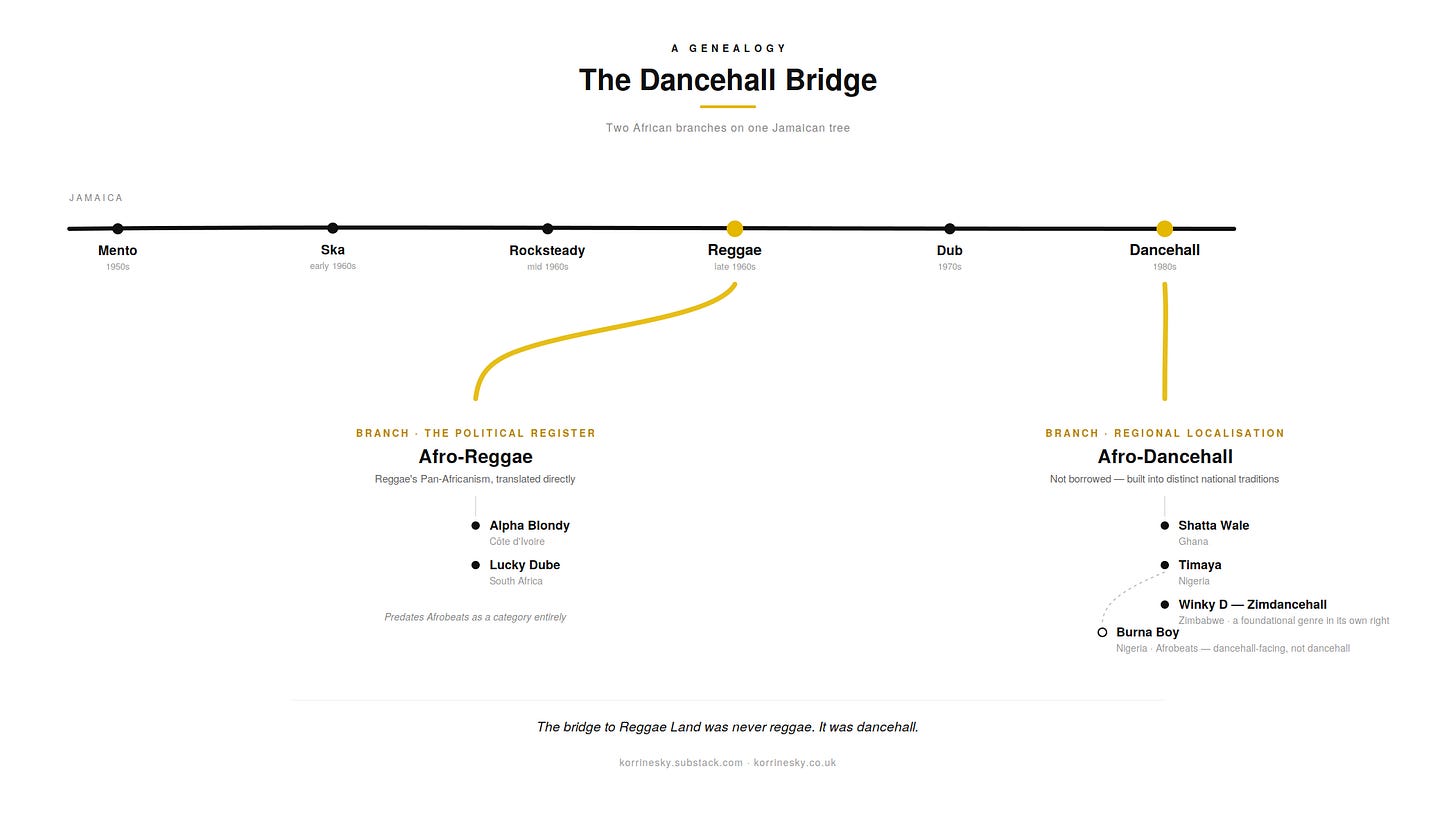
Burna’s strongest musical relationship to Reggae Land runs through dancehall, not through any pretense of being a roots reggae artist. He’s not the only major Nigerian artist working this seam either. Wizkid’s “Come Closer” was built as an explicitly dancehall-inspired record, and his feature on Drake’s “One Dance” sat on a Caribbean-sourced sample and rhythm at the centre of one of the best-selling singles of the decade. The relationship isn’t a one-off Burna project. It’s a pattern running through Afrobeats’ biggest names.
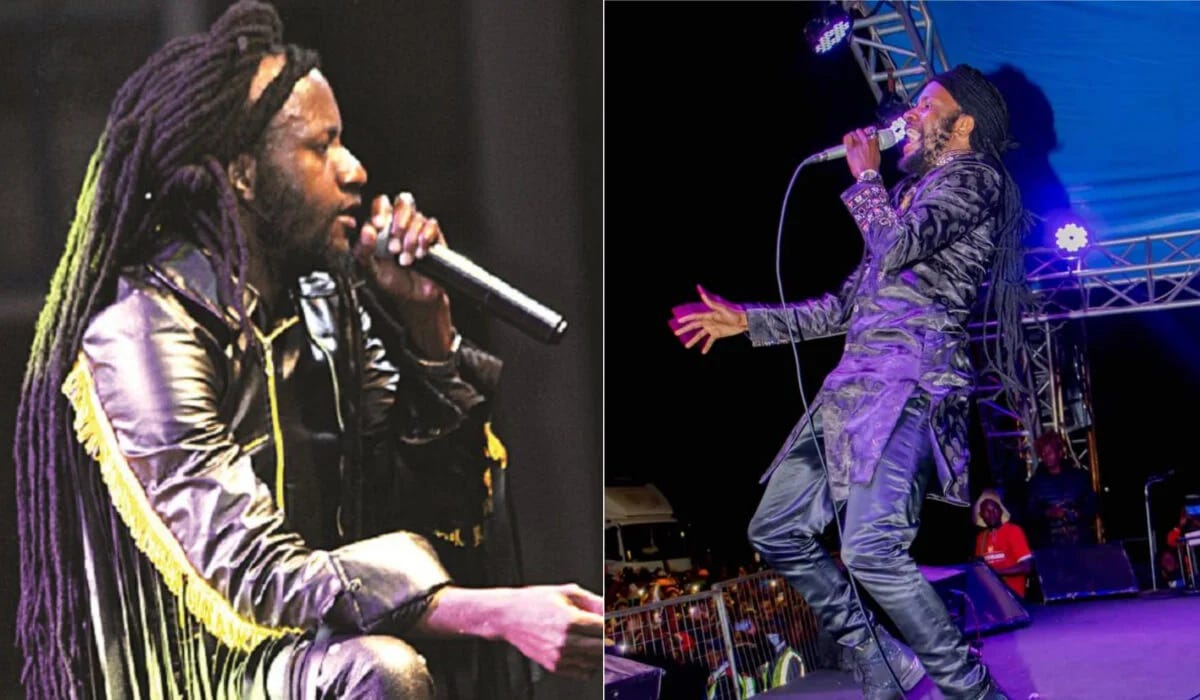
When dancehall travelled through Africa, it wasn’t reproduced unchanged, it was localised into distinct regional traditions. Ghana built one of the most visible through Shatta Wale, for whom dancehall isn’t a borrowed reference but a foundational identity. Nigeria produced its own lineage through Timaya, the wider environment Burna’s dancehall-facing work sits inside. Zimbabwe went furthest: Zimdancehall, carried by Winky D above all, isn’t Jamaican dancehall performed by Zimbabweans, it’s a foundational Zimbabwean genre with its own history and social codes, born out of the country’s independent studios.
Alongside that, African reggae artists like Lucky Dube and Alpha Blondy translated reggae’s political language into their own struggles long before Afrobeats existed as a category, and reggae found ideological kinship even outside its own family: Thomas Mapfumo’s Chimurenga transformed the mbira into electric popular music against Rhodesian rule, using African-derived rhythm for the same anti-colonial purpose reggae served in Jamaica, despite the two forms emerging independently.
If Shatta Wale or Winky D headlined Reggae Land, would the objection to Burna be the same? Maybe. But if it wouldn’t, the real disagreement isn’t that African dancehall has no relationship to the festival. It’s that Burna’s particular scale, and his association with Afrobeats specifically, change what the booking means.
Shared ancestry does not abolish authorship
It’s tempting to turn the Africa-Jamaica relationship into a comforting circle: African rhythms crossed the Atlantic, Jamaica made reggae, reggae returned to Africa, Africa made Afro-dancehall, and now the music has come home.
But the crossing at the centre of that story wasn’t a voluntary exchange. It was the transatlantic slave trade. People were taken from distinct societies with different languages and religions, and the systems built around them, plantation slavery, then colonialism, worked to fracture those identities. What survived did so through adaptation, reorganised under specifically Jamaican conditions. Mento, ska, rocksteady, reggae, dub and dancehall are not African music that stayed abroad for a few centuries. They were created through rupture, and Jamaica is their author. Shared ancestry doesn’t abolish cultural specificity, and Pan-Africanism becomes empty when it treats Africa and the diaspora as one interchangeable mass.
But the history doesn’t stop there. Jamaica’s own political imagination repeatedly turned toward Africa, and it’s worth being precise about what that meant. Marcus Garvey wasn’t simply arguing that Africa was a spiritual homeland. He was arguing that Black people needed institutions they actually owned: shipping lines, businesses, schools, self-governed economic power. That was the political core of Garveyism, not the sentiment attached to it. Rastafari inherited that politics along with the sentiment, and it shaped reggae’s entire imagination. Africa wasn’t decoration inside roots reggae. It was Zion, origin, political destination, the imagined alternative to Babylon. Bob Marley’s “Zimbabwe,” and his performance at the country’s 1980 independence celebrations, show that reggae’s Pan-Africanism wasn’t only symbolic. A culture cannot invoke Africa as spiritual origin and political destination, export that story across the continent, and then treat actual African participation as inherently foreign when the exchange starts moving the other way.
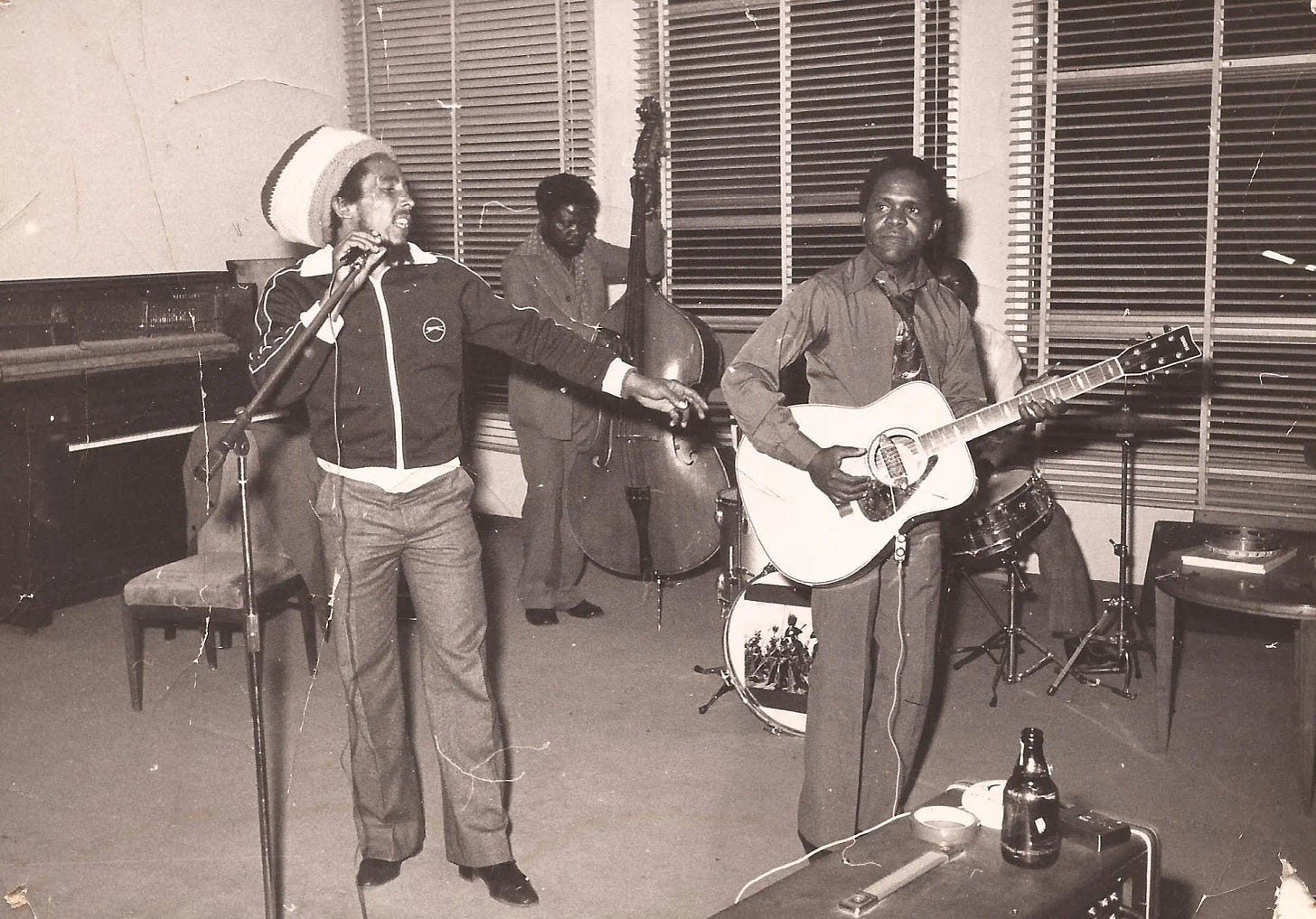
A musical tradition built on Garvey’s insistence that Black people needed institutions of their own is now being debated inside a festival Jamaicans don’t own.
The politics that produced reggae’s Africa was about self-determined ownership. The festival carrying reggae’s name today has almost none.
There’s an asymmetry worth naming here too. Reggae’s politics repeatedly imagined Africa: as homeland, as liberation, as an unfinished political project. Afrobeats has rarely imagined Jamaica the same way. One tradition built Africa into its philosophy. The other has largely built Jamaica into its sound. That doesn’t invalidate Burna’s participation, but it might explain why some Jamaicans experience this relationship as one-directional even where the musical exchange is real.
Burna was not a cultural tourist, but participation isn’t stewardship
Burna’s connection to Jamaican music isn’t invented for this booking. “Different,” with Damian Marley and Angélique Kidjo off 2019’s African Giant, put him alongside reggae’s most direct bloodline. And “Talibans II,” his 2023 remix of St Kitts-born dancehall artist Byron Messia’s breakout hit, is sonically dancehall rather than reggae-adjacent Afrobeats, and one he still performs live regularly, Reggae Land included. None of that makes him Jamaican, and none of it automatically entitles him to a headline slot. But it does make the claim that his presence was culturally arbitrary hard to sustain.
That said, participation and stewardship are not the same thing, and the question is worth asking of Burna too, not just the audience that objected to him. Collaborating with Jamaican artists shows he can draw from the culture. It doesn’t, on its own, answer whether he’s put anything back. As far as is publicly known, no joint project with Shatta Wale, who operates at a scale closer to Burna’s own, or a credited nod to Winky D’s place in Zimdancehall’s development, has surfaced, though the absence of a public collaboration isn’t proof of the absence of any effort. Either way, that kind of reciprocity would cost him little and would say more about his relationship to the culture than another feature verse. Borrowing sound is not the same as investing in the people who made it. If he wants to stand at the summit of an institution built on Jamaican culture, reciprocal cultural leadership isn’t optional. It’s the price of the position.
Jamaican sovereignty is not paranoia
The strongest argument against the booking isn’t that Burna has no relationship to reggae or dancehall. It’s that Jamaica has watched its culture become one of the world’s most successfully extracted resources. The sound travels, the patois becomes advertising language, the dancehall choreography becomes global pop performance, the whole aesthetic becomes a lifestyle category sold alongside clothing and cannabis and holidays, and Jamaica doesn’t always retain proportional ownership of the industries that monetise it.
Against that history, protecting a headline slot isn’t necessarily narrow nationalism. A Jamaican fan asking why the biggest name at a festival called Reggae Land is Nigerian may not be rejecting Africa. They may be asking why Jamaican culture keeps supplying the institution’s value while someone else occupies its most powerful position.
That’s sharpened by scale, and the honest answer to “why Burna” probably isn’t cultural at all. It’s commercial. He wasn’t the African artist with the deepest ties to dancehall. He was the one with the biggest ROI. A promoter chasing a record-breaking sellout books the name that guarantees the return, not the name with the closest relationship to the culture.
That is where the tokenism becomes visible, and it’s not really about Burna specifically. Choosing him instead of Stonebwoy, Shatta Wale or Winky D treats African music as one interchangeable category rather than a set of distinct traditions with their own histories and relationships to Jamaica. It’s the same logic that treats “Black music” as a single thing instead of many, and it’s worth naming plainly. All Black people are not the same, and neither are their genres. Diversity is easiest when it can be outsourced to one person. A festival can hit its revenue target by booking the biggest available African name and still fail to represent the actual relationship between African and Jamaican music, because ROI and cultural legibility are not the same achievement.
Diversity is easiest when it can be outsourced to one person.
Who owns the stage?
Sovereignty can’t rest on selective borders. If dancehall artists routinely headline Reggae Land, Burna can’t be dismissed simply for not being roots reggae. If white British and European artists earn belonging through participation, nationality can’t be an automatic disqualification. Whatever the actual standard is, it needs to be stated honestly. “He isn’t reggae” is not that standard. The lineup disproves it.
Reggae Land is produced by JBM Music, a Manchester-based promoter run by Jorge Meehan and Brian Murphy. That doesn’t make the festival illegitimate, people can build meaningful platforms around cultures they weren’t born into. But it means Jamaica created the culture, a British company controls the platform, and Jamaican fans are being asked to defend their culture’s sovereignty through consumer reaction, because they don’t own the institution monetising it. They can object. The promoter can still sell the ticket.
That’s the gap between cultural ownership and institutional power, and commercially, Burna Boy was a clean win by any measure: Reggae Land’s original weekend sold out in record time, prompting the Friday expansion specifically to meet demand, and Burna opened the festival’s biggest edition yet. That proves demand. It doesn’t prove cultural legitimacy, and it’s the same gap that let the festival book one globally dominant African artist without visibly programming the wider African reggae and dancehall ecosystem that would have made the booking legible as exchange rather than acquisition. Shatta Wale, Winky D, or a segment built around Lucky Dube’s legacy could have shown Reggae Land understood Afro-dancehall as a tradition. Instead it booked the biggest name. That may only prove it understood Burna Boy’s market.
Markets are good at telling us what people will buy. They’re much worse at telling us what an institution should represent, or whether growth is strengthening the ecosystem whose credibility made the growth possible. Real accountability would look like something more specific than a bigger name on the poster: shared curatorial input from Jamaican and African practitioners, dancehall’s African lineage programmed across stages rather than represented by one superstar, deliberate collaborations built ahead of time rather than assembled after the backlash. None of that happened here. That doesn’t undo what Burna built with Jamaican artists over a decade of actual records. It just means the festival hasn’t yet built anything comparable with the culture it borrowed to make this booking make sense.
The border was never genre
The Burna Boy debate exposed a rule Reggae Land never stated. The festival could stretch reggae across dancehall, dub, ska, jungle, carnival and white participation. But when an African artist took the highest position, some of its audience decided the boundary had finally been crossed.
That doesn’t prove Afrophobia on its own. It may be commercial anxiety, or a legitimate defence of Jamaican sovereignty, or frustration that Afrobeats has become the industry’s default label for African music. But Afrophobia shouldn’t be ruled out either. It rarely announces itself outright. Sometimes it just looks like a sudden demand for purity that was never applied to anyone else, welcoming African participation only while it stays smaller, symbolic, and beneath the Jamaican centre. Burna didn’t arrive beneath it. He arrived as the headliner, and that changed what his presence meant.
Burna was right that genres shouldn’t become prisons. But borders aren’t always about exclusion either. Sometimes they’re one of the few tools a community has to negotiate terms, credit and value on its own work, rather than watch it get absorbed for free by whoever holds the bigger platform.
Borders were never really the problem here. Ownership was.
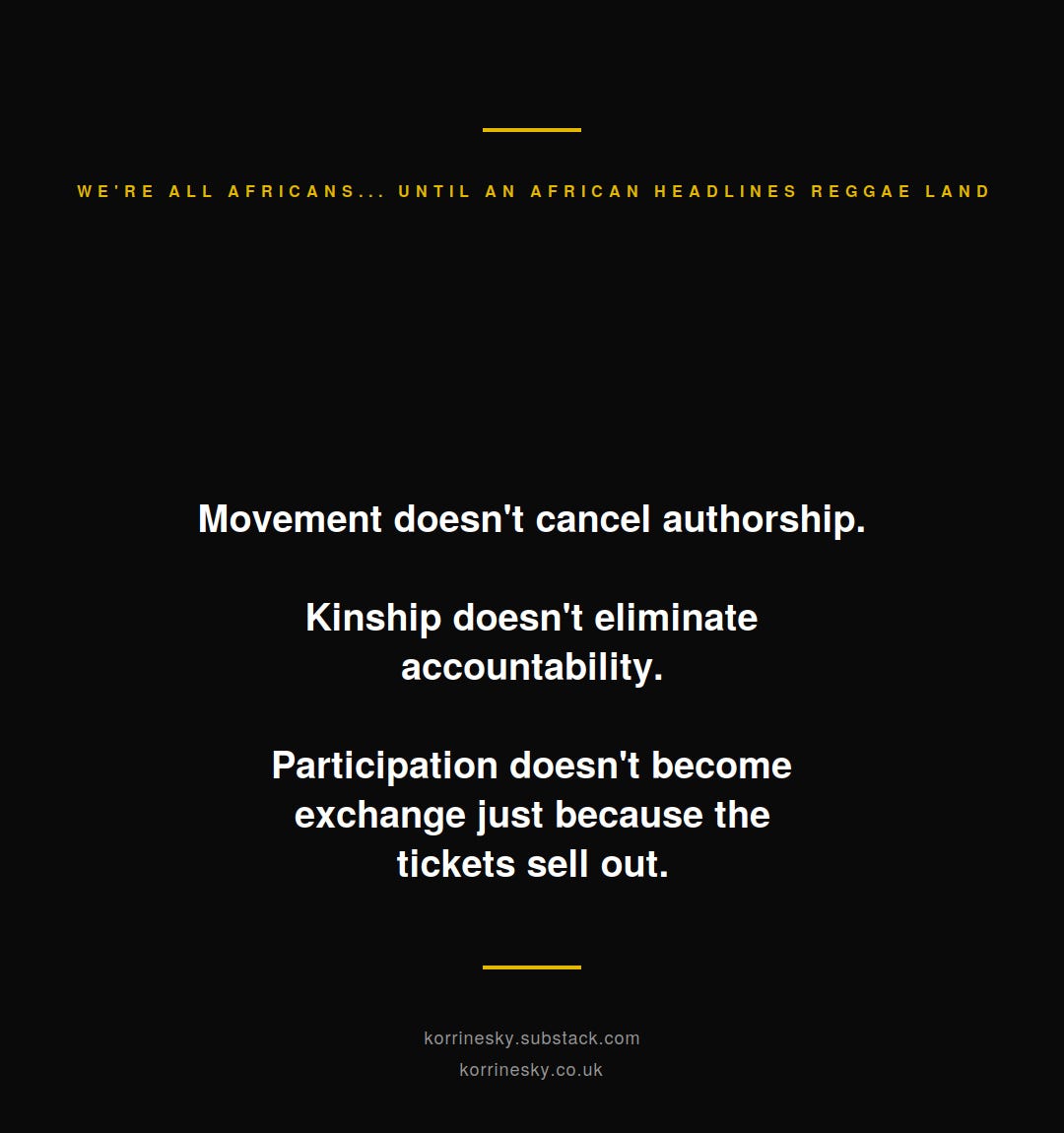
Movement doesn’t cancel authorship. Kinship doesn’t eliminate accountability. Participation doesn’t become exchange just because the tickets sell out.
Culture & Commerce is a reader-supported publication. To receive new posts and support my work, consider becoming a free or paid subscriber.
Culture & Commerce
Get the next essay first.
Culture, brand power and influence, read straight from my desk. No spam, unsubscribe anytime.
Prefer Substack? Follow Culture & Commerce there.
Originally published in Culture & Commerce. Read the original post.