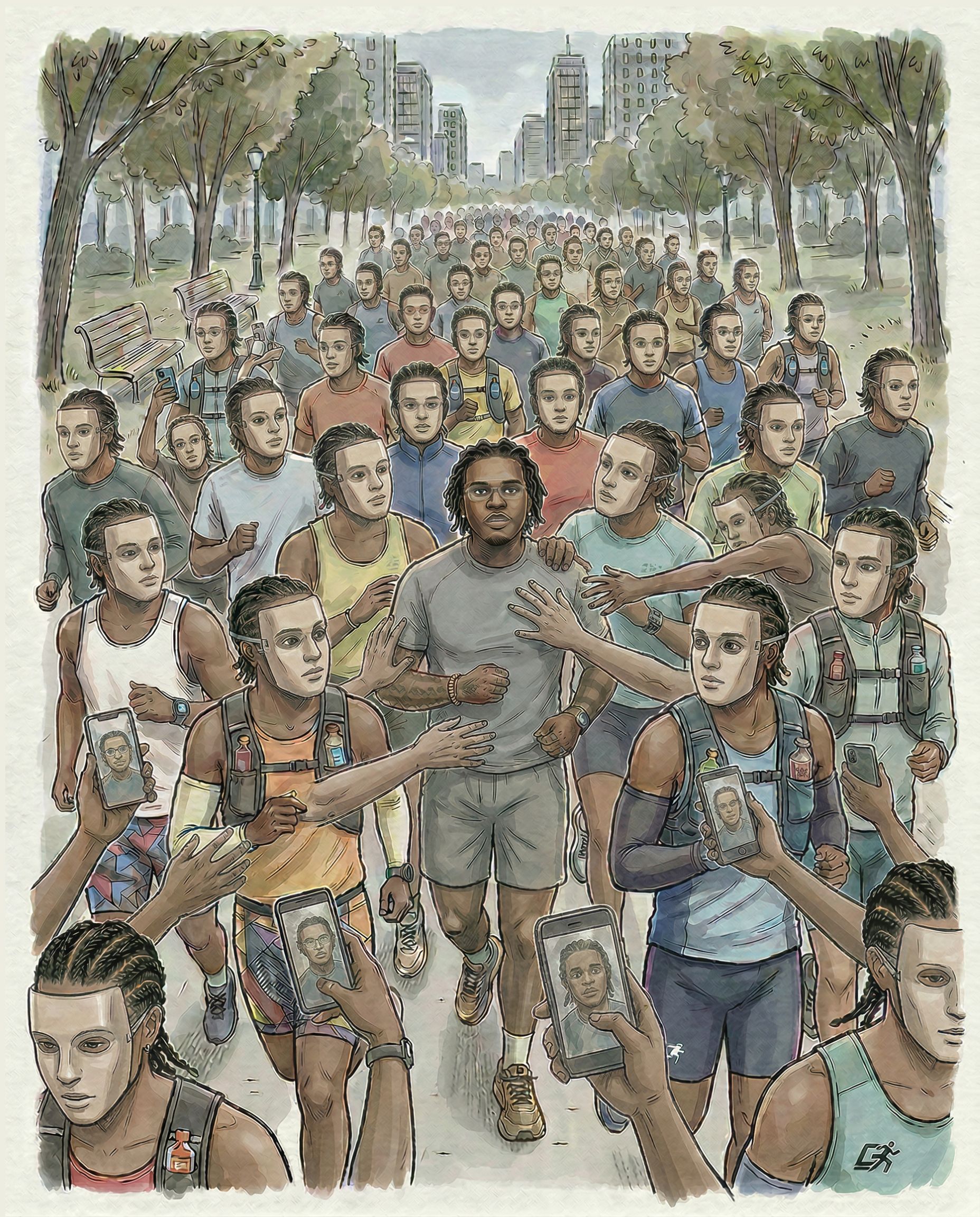
The Gunna run club isn’t really about running. Structurally, it is a controlled environment built around proximity.
Listen to this essay
Narrated version
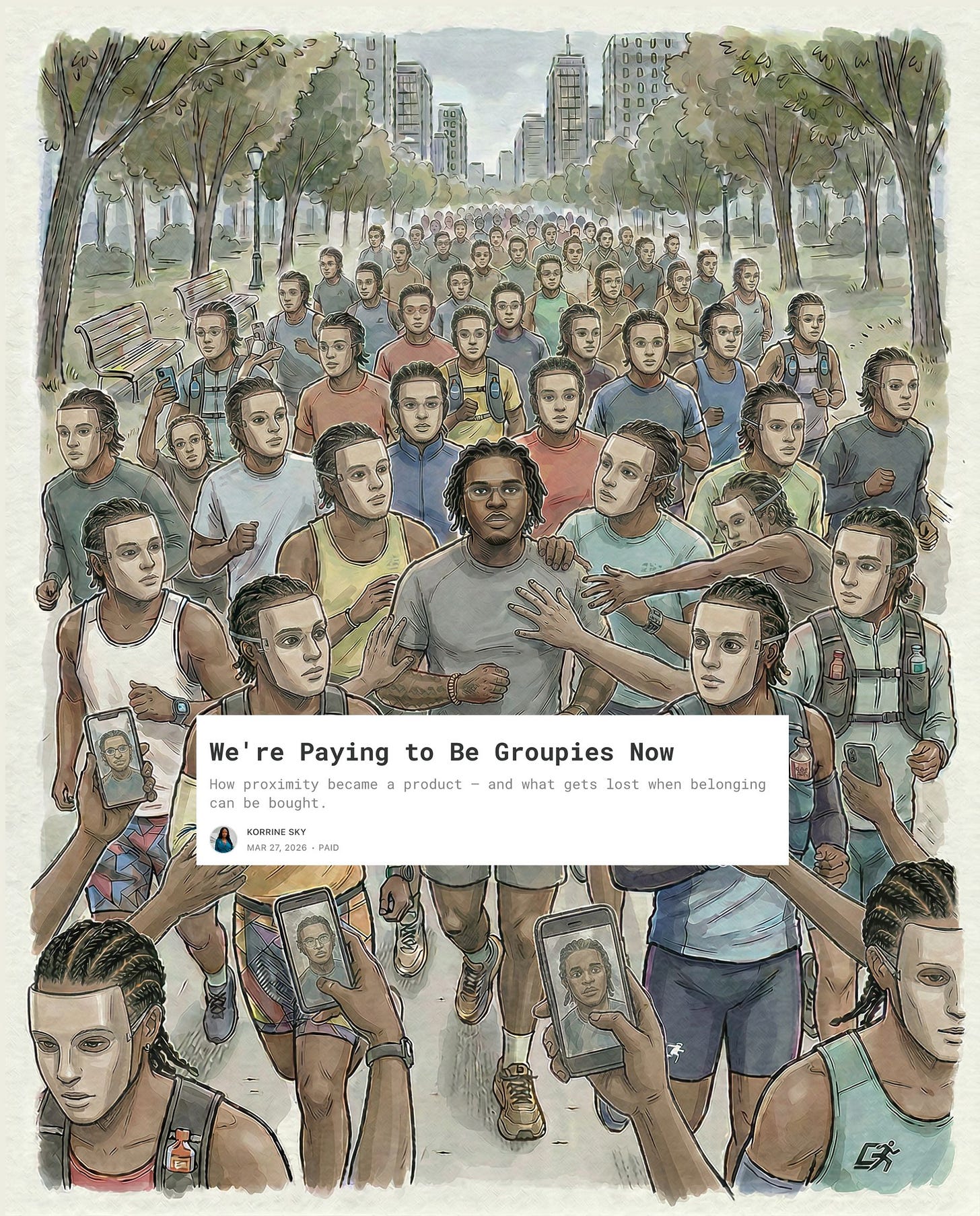
The Gunna run club isn’t really about running. Structurally, it is a controlled environment built around proximity.
A £50 entry fee, brand partnerships, a crowd organised around access to a single person who is not performing, not elevated, but simply present. That shift might appear minor, but it fundamentally alters the conditions of interaction. When the artist is no longer on stage but embedded within the crowd, the boundary between observer and subject becomes unstable. What follows is not incidental. It is produced by the structure itself.
For most of pop culture history, access to artists was unpredictable. Fans waited outside venues, stood behind barriers, or relied on chance encounters. Distance was not only physical; it was structural. It created hierarchy, anticipation, and mystique.
What has changed is not simply that artists are more visible. It is that proximity itself has become something that can be deliberately designed and sold.

Run clubs, meet-and-greets, listening events, and backstage experiences are not simply engagement tools. They are formats for distributing access. In this model, proximity is no longer a byproduct of fandom; it is the product itself.
Chris Brown’s meet-and-greet packages make this dynamic particularly visible. For a significant fee, fans are offered physical closeness, photographs, and a brief but highly charged interaction. The images themselves are often deliberately intimate, with bodies positioned in ways that blur the line between fan and partner. He frames this as appreciation — as giving fans something meaningful in return for their support.

And on one level, that framing holds.
On another, it reveals something more uncomfortable. What is being sold is not simply time or access, but a carefully staged version of intimacy designed to feel real, even when it is not.
What makes this model especially effective is that it does not end with the interaction itself. It produces images.
Those images circulate far beyond the moment, functioning as a form of user-generated narrative. Fans are not simply documenting proximity; they are actively shaping how it is perceived. The intimacy feels authentic because it is experienced and then distributed by the people involved.
In that sense, the interaction extends beyond the individual fan. It becomes part of a broader visual language that can soften, reinforce, or reframe how the artist is understood — particularly in areas where perception is already contested.
The moment does not end when the interaction does. It becomes content.
From audience to participant
The significance of these formats lies in what they allow people to believe.
It is not simply that they attended an event, but that they were close enough for the interaction to feel personal. That shift — from observation to perceived interaction — alters the nature of the relationship. What was once clearly one-sided begins to feel reciprocal, even if it is not.
Once that perception takes hold, behaviour changes accordingly. People no longer act as passive audiences. They move closer, insert themselves into the moment, and attempt to position themselves within it.
This is not an aberration. It is the system functioning as intended. When proximity is engineered, people respond as though it carries meaning.
However, the behaviour seen in these environments does not originate there.
It is built over time through what might be described as ambient intimacy — the accumulation of repeated, low-level exposure that creates the sense of a relationship. Through social media, interviews, and music tied to personal experiences, audiences develop a familiarity that feels relational rather than observational.
By the time someone arrives at a physical event, they are not encountering the artist as a stranger. They are encountering someone they feel they already know.
The event does not create that sense of closeness. It validates it.
Which means the relationship does not begin at the point of contact. It arrives there already formed.
This is what makes the behaviour feel justified from the inside. It is not experienced as intrusion, but as confirmation of an existing connection.
Most people recognise this dynamic in some form — following someone closely over time, attaching their work to personal moments, developing a sense of familiarity without direct interaction.
Under normal conditions, that familiarity is contained by distance.
These formats remove that constraint.
Who’s really in the room
It is also important to recognise that these spaces are not populated by a single, uniform type of fan.
Some attendees are there out of genuine admiration. Others are motivated by proximity to influence, visibility, or opportunity. Some treat these environments as networking spaces, while others experience them as something closer to a personal moment.
In many cases, these motivations coexist.
This matters because the structure collapses them into the same form of proximity. It does not distinguish between emotional, strategic, or transactional intentions.
And once proximity is standardised, it becomes difficult to control what it signifies.
For one person, it is a fleeting experience.
For another, it is access.
For someone else, it is a signal — or even an opening.
The artist cannot regulate those interpretations, but remains positioned at the centre of them.
The economics of intimacy
There is also an economic dimension to this shift.
Access is no longer incidental; it is structured. Entry fees, VIP tiers, and premium experiences create a hierarchy of proximity where closeness is differentiated and priced.
Historically, proximity to an artist implied something specific. It suggested access, trust, or a position within a cultural ecosystem.
Now, that meaning has shifted.
Proximity increasingly signals the ability to pay.
This does not eliminate the emotional dimension of fandom, but it reframes it. Participation becomes conditional. Intimacy becomes stratified.
And in becoming stratified, it becomes performative. It is no longer enough to be close. The value lies in being seen to be close.
What is being sold, increasingly, is not simply access to the artist, but access to the feeling of belonging near them.
And for most people, that belonging is temporary.
The trade-off: proximity and power
The tension created by this model is structural.
Proximity builds connection. It increases engagement, loyalty, and immediacy. But it also reduces distance.
Distance has historically been central to cultural power. It creates space for projection, scale, and mystique.

An artist like Beyoncé operates within that logic. Her visibility is controlled, her appearances are limited, and access is tightly managed. The result is a form of impact that relies as much on absence as presence.
However, that model also has limitations.
As artists move beyond music into products, partnerships, and lifestyle extensions, distance becomes more difficult to sustain. These ventures require context. They require the audience to understand how the artist lives, not just what they produce.
This is where proximity becomes functional.
A run club does more than create access. It situates the artist within a recognisable set of behaviours — fitness, routine, community — and in doing so, translates them into a lifestyle.
By contrast, when artists who maintain distance attempt similar extensions, the gap becomes visible. The product exists, but the surrounding context is less defined.
This tension has surfaced in the reception of some of Beyoncé’s ventures, where the question is not necessarily about quality, but about credibility — whether the audience can locate her within the category she is entering.
Distance protects the myth.
But it also limits how that myth can be extended.
The cost of being known
What is emerging is not a loss of influence, but a shift in how it is produced.
Proximity-based models are easier to monetise, scale, and measure. They generate continuous interaction and make the relationship feel immediate.
But they produce a different kind of cultural presence.
They produce familiarity.
And familiarity changes the terms of engagement.
It makes the artist easier to understand, easier to relate to, and, over time, easier to replace.
The question, then, is not whether proximity works.
It does.
The question is what it produces.
Because proximity builds attention.
But distance builds power.
And those are not the same thing.
Share
Subscribe now
Culture & Commerce
Get the next essay first.
Culture, brand power and influence, read straight from my desk. No spam, unsubscribe anytime.
Prefer Substack? Follow Culture & Commerce there.
Originally published in Culture & Commerce. Read the original post.