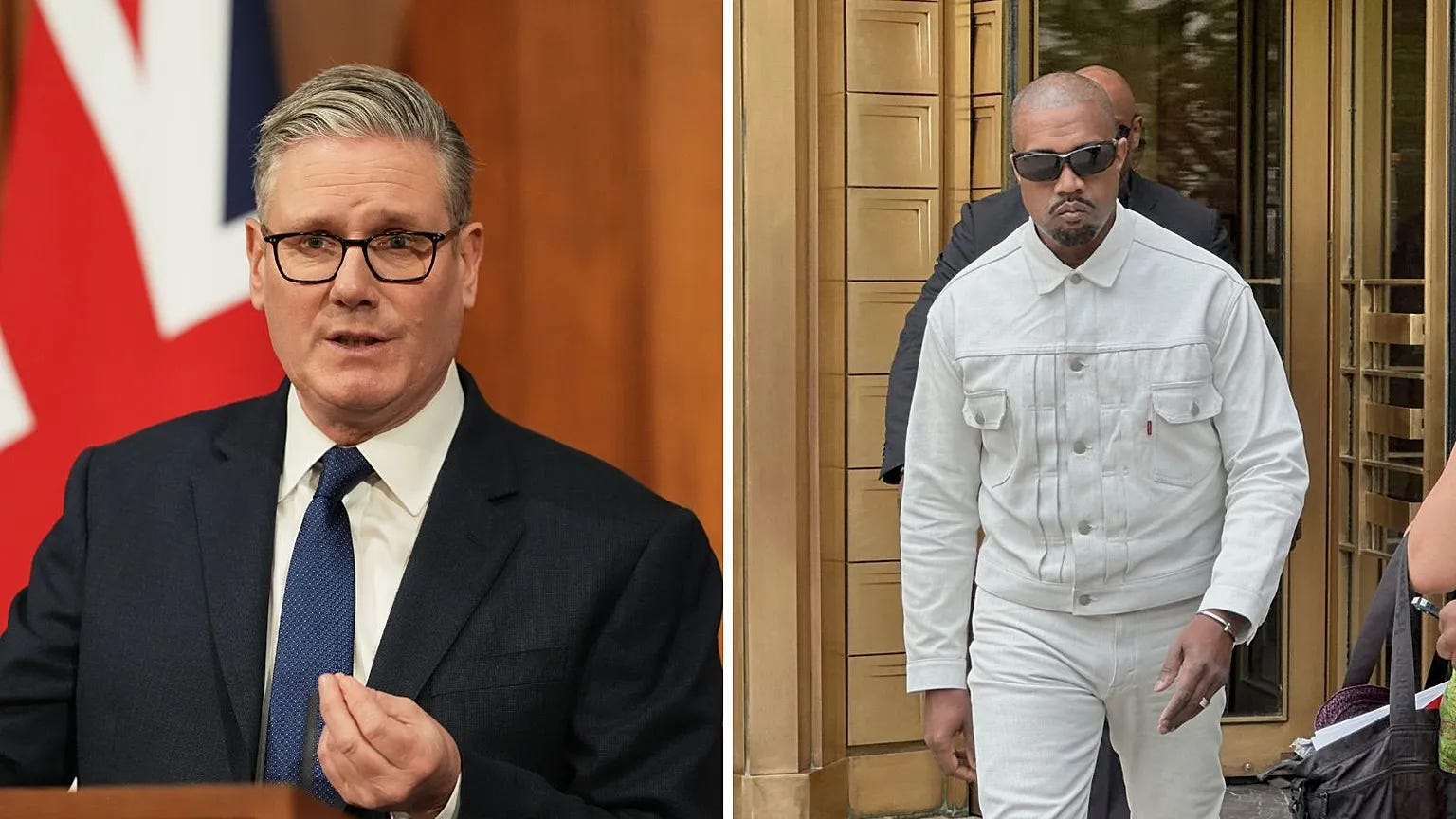
Kanye Said Heil Hitler. Everyone Said Fine — Until They Didn’t.
Korrine Sky · April 2026 · 12 min read
This essay was written as the story unfolded. It ends where the story ended — with a government ban, a cancelled festival, and every institution that approved the booking pretending it never did.
Listen to this essay
Narrated version
This essay was written as the story unfolded. It ends where the story ended — with a government ban, a cancelled festival, and every institution that approved the booking pretending it never did.
I am a Kanye fan. Not a casual one. Not an “I liked him before he went crazy” one. A genuine, cemented, this-man-changed-how-I-hear-music fan. I still listen to him. This morning, probably.
He said heil Hitler. Sold swastika t-shirts. Declared himself a Nazi. Was booked to headline Wireless Festival in London this July, all three nights. Then the Home Office banned him from entering the UK. The festival was cancelled.
I don’t have a clean take. The people who pretend they do are the most interesting part of this story.
Everyone Has a Problematic Fave. That’s Not an Accident.
Chris Brown beat Rihanna so severely on Grammy night 2009 that she required hospital treatment. The photographs were published. The conviction was public record. Last year he toured the UK to sold-out venues. His fans did not leave. The industry did not leave. The brands came back. His career is, by any measurable standard, fine and he is welcome here.
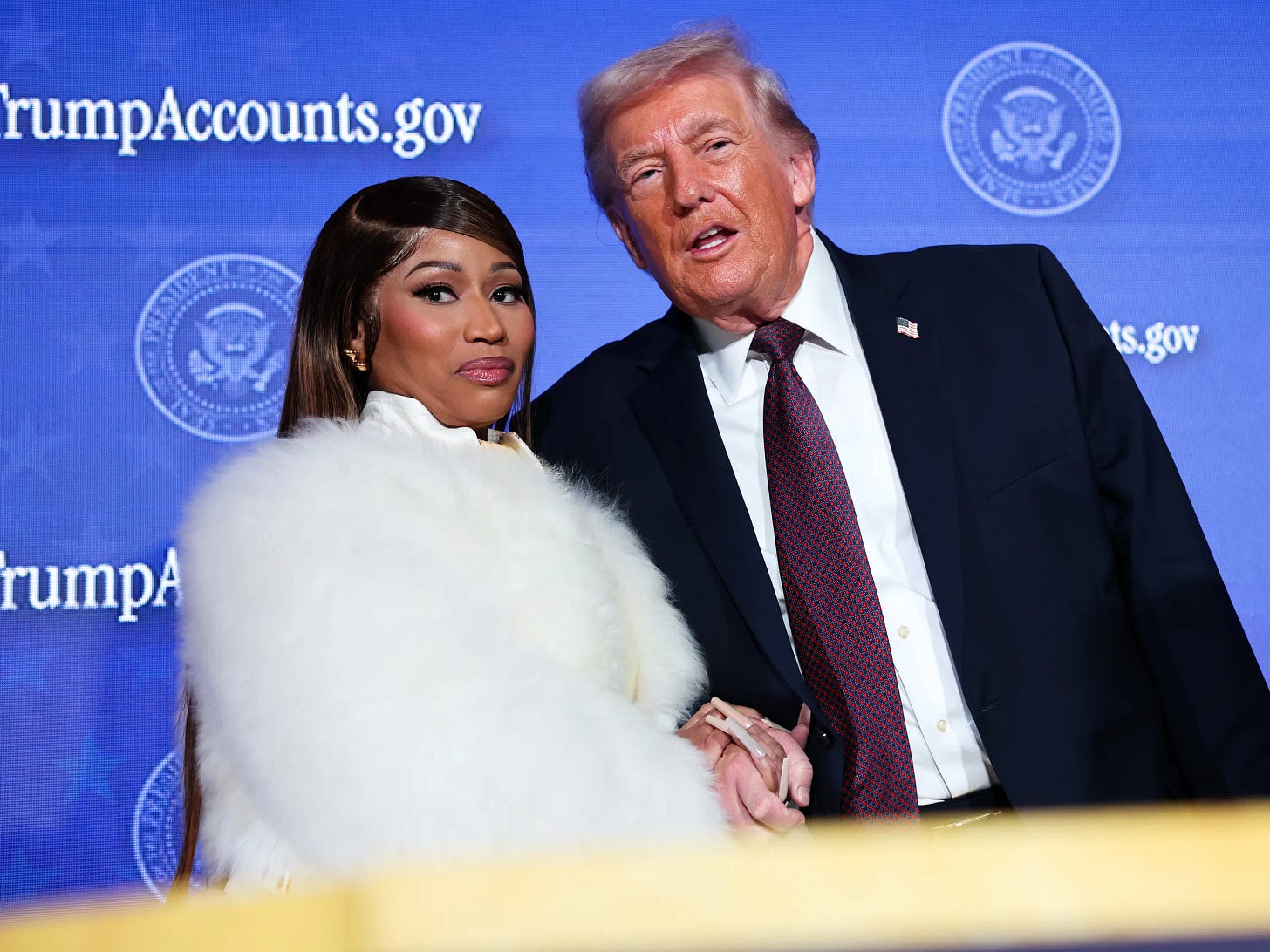
Nicki Minaj married a registered sex offender, spent years using her platform to discredit women who spoke out against people in her circle, and has since reinvented herself as MAGA Minaj — turning on the LGBTQ+ fans who built her career and the immigrants who filled her stadiums. Tory Lanez was convicted of shooting Megan Thee Stallion in both feet and his fanbase spent three years making her the villain of her own assault. Diddy — the allegations are so extensive, so documented, and so specific that the word allegations barely contains them anymore.
And then there is R Kelly. Convicted. Sentenced. The documentary watched by millions who had been singing his songs the week before. He is the one name on this list the industry actually buried and even then it took decades of abuse, a Netflix series, and a survivor-led campaign that refused to be ignored. People still stream him. The numbers are just quieter now.
All of them have catalogues that people return to daily. Including people who know exactly what I just said.
And then there is the most instructive example of all; not a musician, not an entertainer, but the most powerful office on the planet. America put their problematic fave in office twice.
This is not hypocrisy exactly. It is something more specific and more uncomfortable.
An artist is not an individual to the people who love them. They are a reflection of a moment. The music gets metabolised into the listener’s identity before the harm becomes undeniable — attached to versions of yourself that predate the controversy and will outlast it. Letting go feels like self-destruction. So most people don’t. They compartmentalise. They keep streaming and tell themselves it is complicated.
It is complicated. But complicated is also very convenient.
They All Said Yes. Then They Said They Didn’t.
Before Wireless said yes, Kanye approached Tottenham Hotspur Stadium — a club with a deep and long-standing relationship with London’s Jewish community. They said no. Quietly. No statement. Just no. Then London Stadium said no. Then Wireless said yes.
Two institutions looked at the same facts and walked away. Wireless looked at the same facts and saw three nights of ticket revenue. But here is the part the outrage cycle conveniently obscured.
Wireless did not act alone. They consulted their sponsors before making the booking. Pepsi, Diageo, PayPal — the same companies that later withdrew with statements about brand safety and shared values — were in those conversations. They saw the booking. They approved it. What changed was not their values. What changed was the public pressure, which made staying more expensive than leaving.
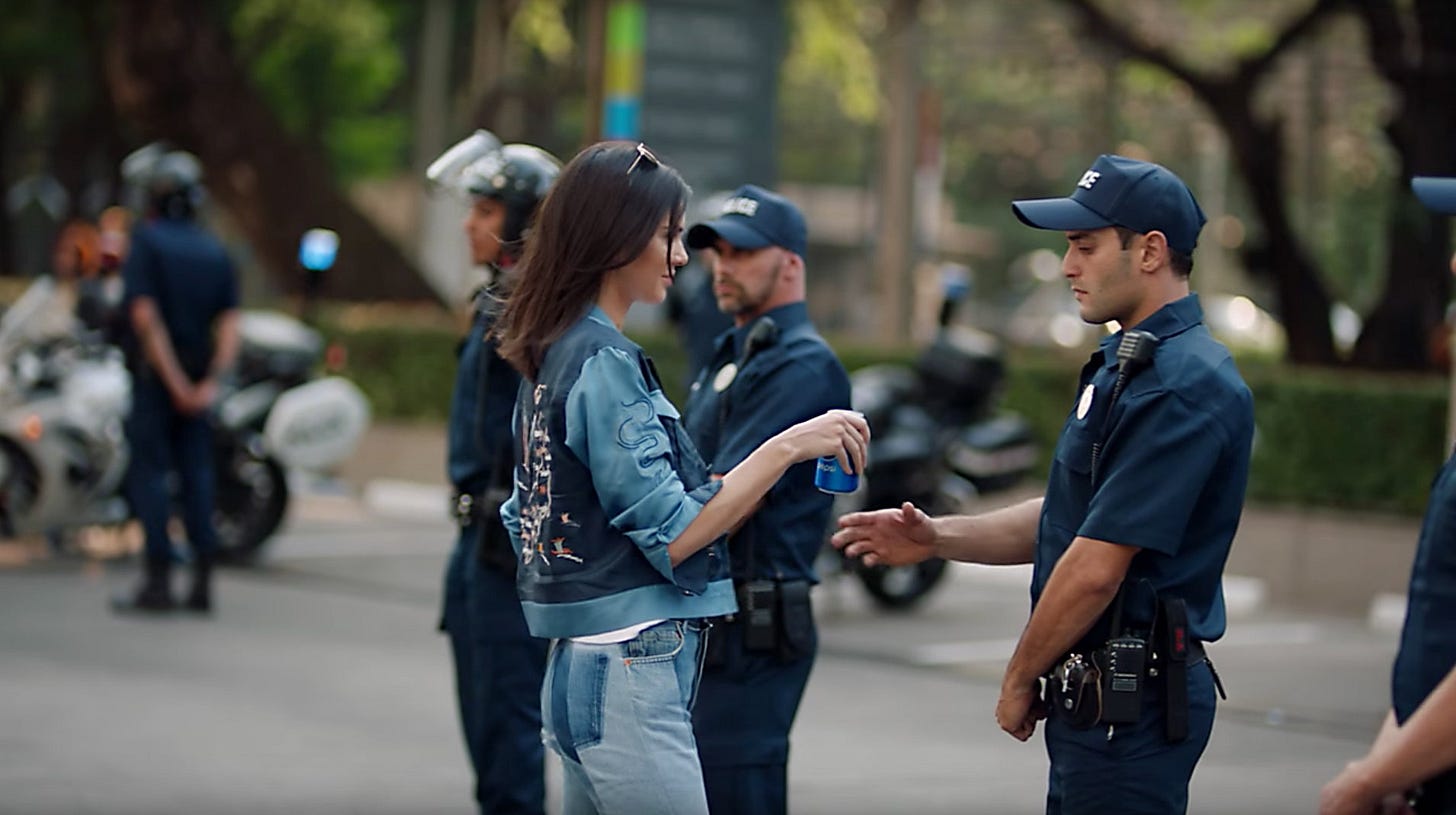
This is the same Pepsi that in 2017 produced an advertisement in which Kendall Jenner resolved police brutality against Black protesters by handing an officer a can of their product. They pulled it within 24 hours, issued an apology, and were back as major event sponsors within months. Brand safety is not a standard. It is a calculation. And the calculation changes the moment the cost does.
Wireless’s statement after the ban said that multiple stakeholders were consulted in advance and no concerns were raised. Either the people running brand safety frameworks at major corporations looked at this booking and genuinely had no concerns — or they did, approved it anyway, and are now rewriting history. Both possibilities tell you everything about what brand safety actually is.
It sounds like a principle. It is a sliding scale that moves entirely depending on how much the brand needs you and how much heat the people above the brand are willing to absorb publicly.
I work in cultural strategy. I have been told directly that having opinions, being political, saying things that make media buyers uncomfortable, is a brand risk. I have watched strategists tell influencers with growing platforms: stay neutral, don’t touch Gaza, don’t post about race, don’t be anything a brand couldn’t put their logo next to without a conversation. The implicit promise is that compliance gets rewarded.
And then Kanye sells swastika t-shirts and eighteen months later he is booked to headline a three-day festival, with full sponsor approval, and everyone acts surprised when it becomes a problem.
The influencer with 50,000 followers gets told not to drink on camera. The artist with 160 million record sales gets told to take out a Wall Street Journal ad and see you in July. Brand safe was never about behaviour. It was always about leverage, who needs whom more, and at what moment the numbers change.
Politicians Condemning Kanye Is Content, Not Consequence — Mostly
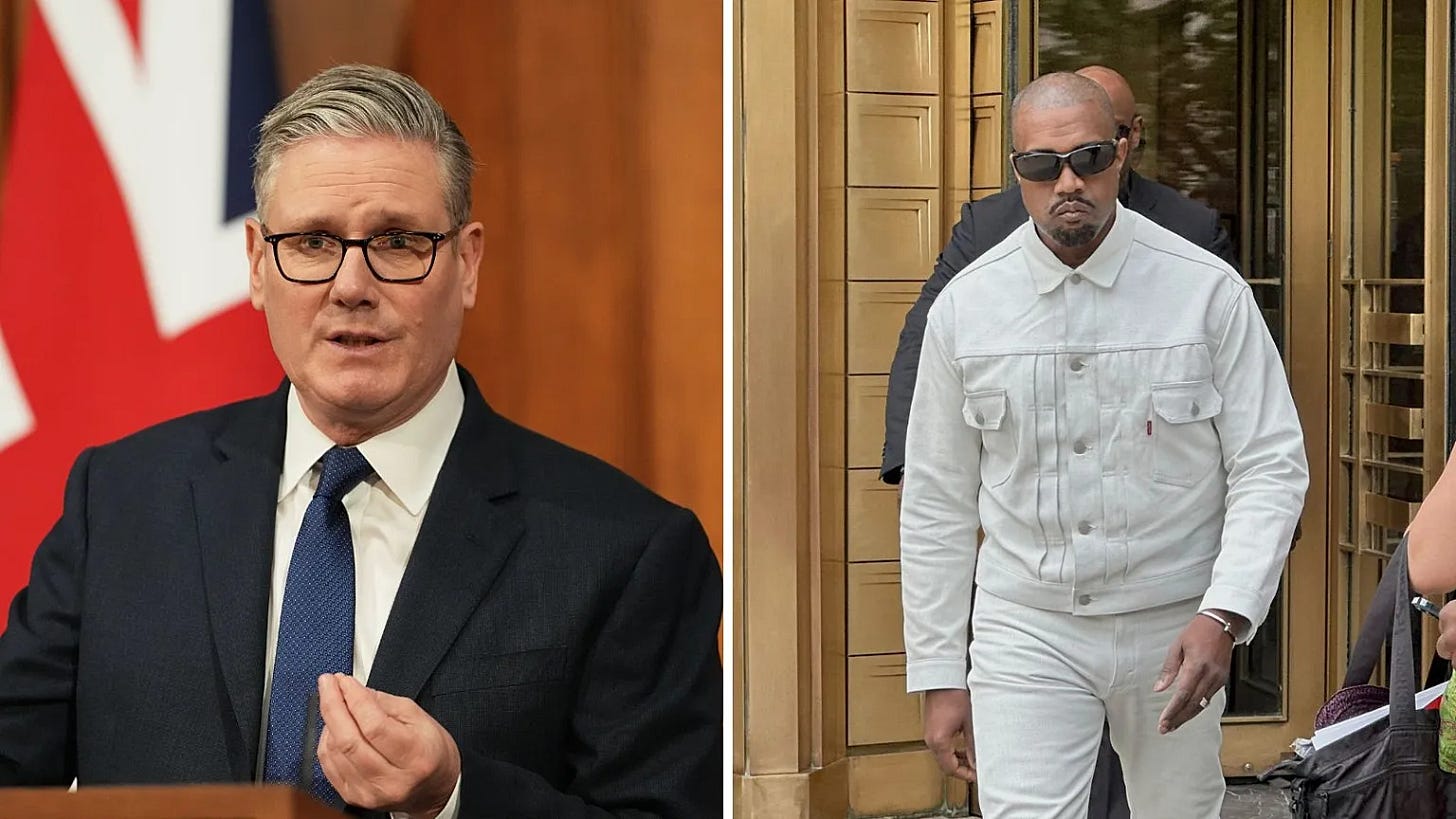
Keir Starmer said Kanye’s booking was deeply concerning before the Home Office had even received a visa application. He said it because it was timely, quotable, and cost nothing. Politicians have become content creators — say something, make it quotable, collect the engagement, move on.
But there is context worth naming here. The dominant public conversation in Britain right now is not Kanye West. It is Gaza — the civilian death toll, the weapons the UK continues to supply to Israel, the question of what this government’s stated commitment to human rights actually means in practice. Politicians who issued statements about a rapper performing at a festival largely did not issue comparable statements about that.
Starmer — who condemned Kanye’s antisemitism — was photographed shaking hands with the Syrian president, a former al-Qaeda leader with documented links to the networks responsible for 7/7. The moral authority being deployed here is selective. It always is.
And yet — the essay has to be honest — Starmer’s government did eventually act. The ETA was granted, reviewed by ministers, and revoked on the grounds that Kanye’s presence would not be conducive to the public good. That is a real consequence. But notice the conditions required to produce it: a full sponsor collapse, a sustained public pressure campaign, a parliamentary question, a moment at which inaction became politically untenable. The machinery of governance did not move on principle. It moved when principle became politically unavoidable. That is not the same thing.
The outrage is the product. And like all products, it is designed for consumption, until the consumption itself becomes the pressure that forces change. Which is what happened here. It is not inspiring. But it is the truth.
The Cancellation Nobody Wanted and Everyone Caused
The festival is cancelled. The ban stands. Kanye issued a statement offering to meet and listen to the UK Jewish community.
What nobody will say clearly about the sequence of events is this: the martyrdom I predicted would follow a Wireless cancellation happened anyway, just delivered by a different hand. A Black artist with a documented mental health condition, banned from the UK by a government whose moral consistency does not survive basic scrutiny, weeks after releasing the biggest hip hop album of 2026. That narrative is already spreading. The ban may have been the right outcome — I think it was — but it was reached by the wrong road, for the wrong reasons, by institutions that had already demonstrated they were not operating on principle.
There is also a consistency problem the government has not answered. Far-right influencers — figures whose explicit purpose is to radicalise and recruit — have been permitted to enter the UK and platform their views without equivalent scrutiny. Tyler, the Creator was banned from the UK in 2015 by Theresa May for lyrics she claimed encouraged violence and intolerance — and had the ban lifted four years later. He said he felt like he’d won some invisible fight. If the standard being applied to Kanye is that presence must be conducive to the public good, that standard should survive contact with other cases. Two-tier rules are not a standard. They are a selection. The question of who decides what is too offensive to platform in Britain — by what measure, applied to whom, with what consistency — did not begin with Kanye and will not end with him. This is now precedent. The next case will cite it.
And the cost of that precedent is not abstract. Wireless generates an estimated £45 million in economic activity across London. Haringey Council receives around £1.2 million from major events annually — money reinvested directly into Finsbury Park, a public green space used by the local community, now facing a funding hole it was not expecting. Haringey is already under significant financial pressure. The people absorbing the cost of this cancellation are not the sponsors who withdrew, or the politicians who issued statements, or the festival that booked him. They are the borough, the park, and the residents who had no vote in any of this.
Why Heil Hitler Cost Him More Than Slavery Is a Choice
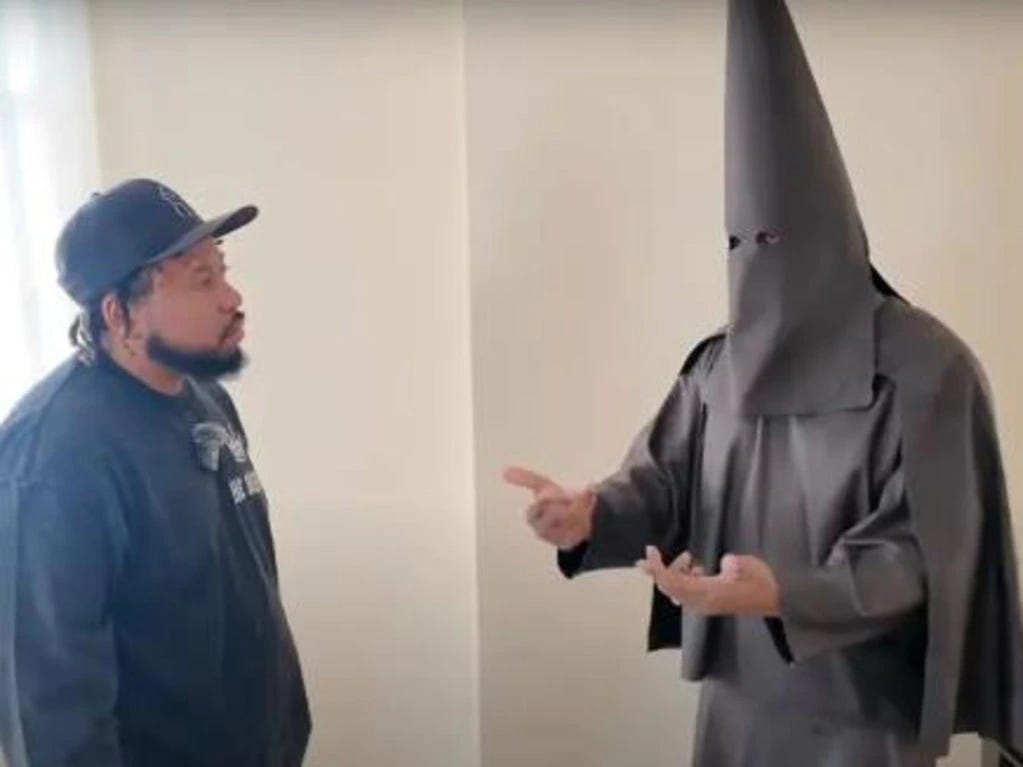
Here is the thing nobody wants to say plainly.
When Kanye said slavery was a choice in 2018, he lost cultural goodwill. The outrage was real and loud. And then Ye dropped and people streamed it and life went on.
When he sold swastika t-shirts and declared himself a Nazi, he lost Adidas, his distribution, nearly everything and was eventually banned from a country. Both were serious moral offences. The consequences were categorically different.
The people with the institutional power to make Kanye’s career expensive sit inside the same networks he directly targeted. When he crossed that line, the response was structural — not just cultural. The infrastructure to make his behaviour costly existed, was personally motivated, and eventually moved. When he targeted Black people — his own community — the outrage was real. But the institutional leverage over the pressure points that actually determine a career was not concentrated in the same way. Black consumers have enormous cultural power. That power does not always convert into the same direct economic consequence at the level of contracts, distribution deals, and visa applications.
Anti-blackness rarely comes with a mental health diagnosis attached. It rarely triggers institutional machinery. It rarely requires a government ban to address. Often it requires nothing at all. The consequences for causing harm operate on entirely different scales depending entirely on who you harmed.
Cancellation follows institutional proximity, not moral principle. Kanye West is the most extreme proof of that available.
The Public Never Left. The Apology Wasn’t For Them.
Bully debuted with 33.2 million Spotify streams in its first 24 hours, the biggest hip hop release of 2026. Sixteen of its eighteen tracks charted worldwide. The public the industry claimed to be protecting never fully left. The attachment was already metabolised — 160 million record sales worth of people who were always going to stream the album, controversy or not.
The Wall Street Journal apology — published in January, addressed to the financial class that had been blocking his money — did not rehabilitate him with the public. The public never needed the apology. What it did was give the infrastructure a narrative to justify reopening the door. The fans were always there. The industry just needed a reason that worked.
Which brings us to the mental health question. Kanye’s bipolar disorder is documented and serious. The question of grace — whether someone can be forgiven for harm caused in the context of mental illness — is not simple, and anyone who answers it too quickly in either direction is not taking it seriously.
But notice what the mental health framing was doing institutionally. It gave the financial class a clean, sympathetic narrative to reopen the door without losing face. Contrast that with how anti-blackness gets treated — those who cause harm through it are rarely offered that framing, rarely face the institutional consequences Kanye faced. The grace we extend, and when, and to whom, follows the same map as everything else in this essay.
The Outrage Is Selective. That Has Always Been the Point.
In the same period that institutions mobilised to prevent Kanye West from performing at a festival, documented evidence of the most powerful men in the world’s connections to a child sex trafficking network sat in court files — largely unexamined, largely unacted upon. Not allegations. Flight logs. Calendars. Testimony. The world kept turning. No sponsors withdrew. No ETAs were revoked.
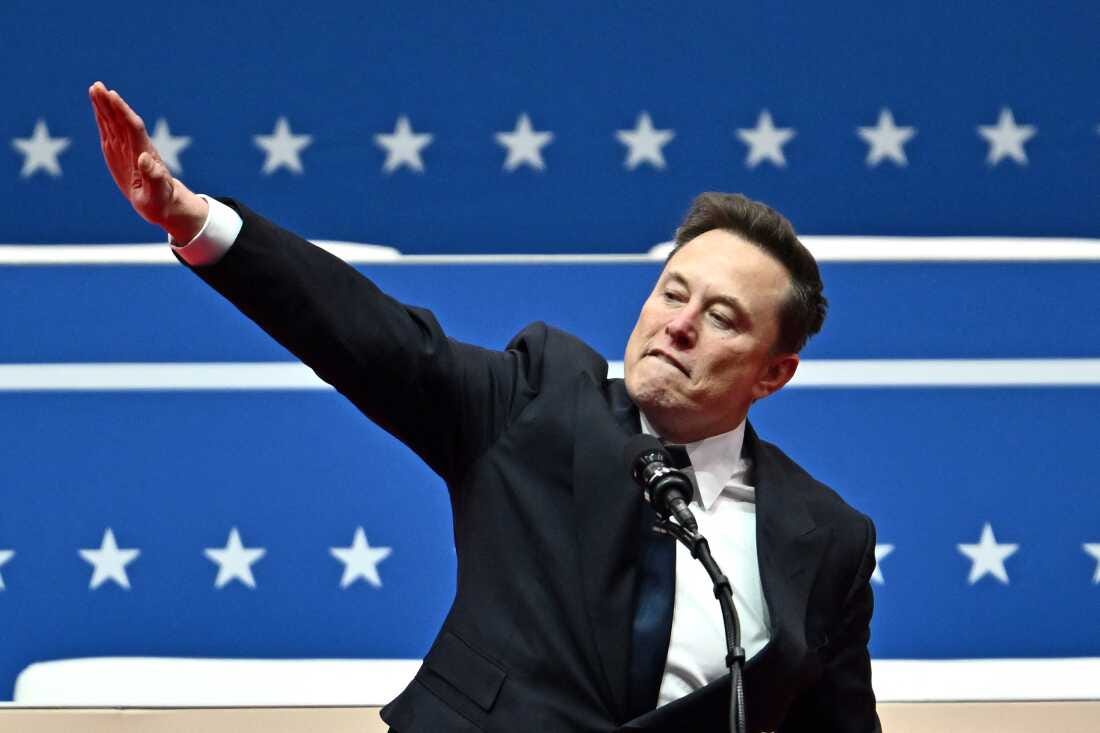
The moral scrutiny we apply to entertainers — to public figures whose power is cultural rather than structural — is inversely proportional to the scrutiny we apply to people whose power is real enough to be dangerous to examine. Kanye said heil Hitler and was banned from a country. Elon Musk performed what historians and politicians described as a Nazi salute at a presidential inauguration rally, in front of a global audience, and was back on X by Monday. The ruling class implicated in documented abuse of power remained, largely, the ruling class.
The outrage is not fake. People are genuinely angry. But it runs in channels specifically designed to direct anger toward spectacle and away from structure. We are encouraged to have opinions about Wireless Festival. The people whose money actually shapes the world we live in are counting on us not having opinions about them.
That is not an accident. It is the design.
What The System Revealed About Itself
The line in this story was never about what was said. It was about who was in the room when it was said, whether they could afford to be associated with it, and when the cost of that association finally exceeded what they were willing to absorb.
Every institution that shapes culture — brands, festivals, governments, industry bodies — operates on that calculation. The pretence that it operates on principle is what keeps smaller creators compliant and uncancellable artists in business. The pretence collapsed publicly over the last several weeks and nobody involved came out clean. Not the sponsors who approved the booking. Not the festival that took the money. Not the politicians who performed concern before eventually acting. Not the government that banned him while maintaining other associations that do not survive scrutiny.
The ban was the right outcome. It was reached by the wrong road. Both things are true, and pretending otherwise — in either direction — is just another version of the same story: institutions performing principle while actually following money.
I listen to him daily. I was not going to the festival. I don’t think either of those things makes me consistent or good. But I know what this story was actually about — not one artist, not one festival, not one government decision. It was about who the system protects, at what price, under what conditions, and who it has always been willing to let pay the cost.
The people paying the cost of this particular decision are not Kanye. They are not Wireless. They are not Pepsi. They are the residents of Haringey, the visitors who bought tickets, the local economy that was counting on £45 million it will not see. The people with the least power in this story are absorbing the consequences of decisions made entirely by the people with the most.
That asymmetry is the story. It always was.
Everyone has a problematic fave. The question is whether you’re honest about what it costs — and who pays.
Culture & Commerce is a reader-supported publication. To receive new posts and support my work, consider becoming a free or paid subscriber.
Culture & Commerce
Get the next essay first.
Culture, brand power and influence, read straight from my desk. No spam, unsubscribe anytime.
Prefer Substack? Follow Culture & Commerce there.
Originally published in Culture & Commerce. Read the original post.