
Every Year,
The Same Panel
Reflections from Aberdeen Music Week 2026, on conversation without consequence, Scotland's touring access problem, and what a sold-out show in a market nobody trusted actually proves.
September 2026 · ~8 min read
Listen to this essay
Narrated version
The panel opened with a question, not a welcome
I was invited to open a panel at Aberdeen Music Week 2026, and I decided not to open it with a welcome. I opened it with a challenge: are we actually changing the music industry, or are we just having the same conversations every year, on a different stage, with a different lanyard.
It wasn't a rhetorical question. I wanted an answer, and I still do.
The music industry loves a panel. It loves a keynote, a roundtable, a "state of the industry" address delivered from a stage to a room of people who mostly agree with each other already. What it is less good at is turning any of that talking into consequence. The same access problems get named every year. The same underrepresented regions get mentioned every year. The same artists get held up as proof that things are changing, while the structures underneath them stay exactly where they were.
So the honest question isn't whether we should keep talking. It's whether the talking is doing anything.
Repetition isn't the problem. Consequence is.
I don't think the answer is to stop talking. Parliament talks. The UN talks. Every institution that is serious about solving a hard problem keeps returning to it, interrogating it from a slightly different angle, checking whether last year's answer still holds. Music isn't exempt from that. An industry built on culture, taste and constantly shifting audiences should expect to keep having versions of the same conversation for a long time.
The problem isn't repetition. The problem is conversation without consequence.
That distinction matters, because it changes what we should actually be frustrated by. Being tired of a topic isn't the same as the topic being wrong. What's wrong is when a panel produces energy in a room for ninety minutes and nothing downstream of it changes: no new booking, no new commitment, no new number anyone is accountable to a year later.


Korrine Sky at Aberdeen Music Week, 9 September 2026.
Scotland doesn't have an audience problem. It has an access problem.
One of the sharpest disagreements I expected to have in that room was about Scotland specifically, and about the wider assumption that certain UK regions and certain audiences simply aren't there.
There are communities across Scotland listening to African, Caribbean and global music who have barely been toured to. Ask a promoter why, and you'll usually get some version of the same answer: the historical ticketing data doesn't support it. But you cannot measure demand in a market you have never actually entered. Absence of data isn't the same as absence of demand. It's a market nobody has tested, being treated as a market that has already been tested and failed.
That's not data. That's an excuse dressed up as one.
I don't think this is unique to Scotland. It's the same logic that keeps certain artists out of certain rooms, certain genres off certain radio playlists, certain cities off certain tour routes: an absence of prior evidence gets quietly reclassified as evidence of absence, and nobody has to take the risk of finding out otherwise.
A test case: Baba Harare's Jiti GodFather tour
Two weeks after that panel, I got to watch what happens when someone tests it anyway, at a scale bigger than a single show.
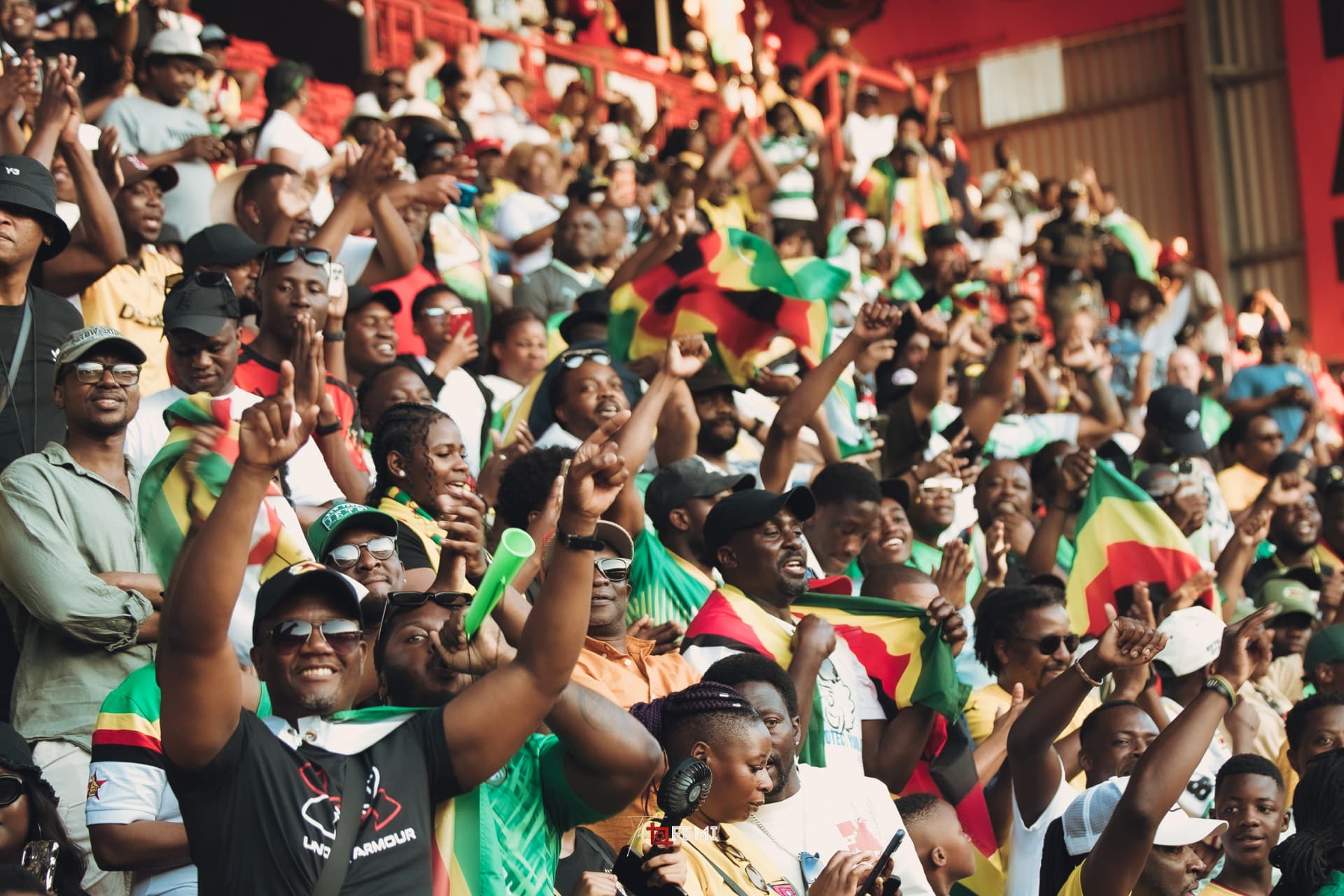
I ran strategy, management and tour delivery on Baba Harare's Jiti GodFather UK tour, an eight-city run from November through July. This wasn't a support slot dressed up as a moment. It was infrastructure: full tour coordination, release strategy across five projects (Greater & Wiser, Prove Them Wrong, Zimbabwean Giant, Vaccine and Generator), and a stadium booking at Unity Cup, where he performed at halftime of Zimbabwe's match against Nigeria, alongside Flavour.
Baba Harare, the Zimbabwean artist and Jiti pioneer, has a strong home audience in Zimbabwe and, going into this run, almost no touring history across the UK. On paper, exactly the artist a promoter would call a hard sell in a market with "no data." Two of the eight dates were markets with no prior track record for him at all: Glasgow, a 300-cap venue, and Norwich, a 2,000-cap venue.
Both sold out. So did every other date on the tour.
Cities, all sold out
Tickets across the run
Sell-out rate
Eight cities. Fourteen thousand four hundred tickets. A hundred percent sell-out rate, off the back of consistent, organic groundwork rather than a marketing budget built to force the numbers. Promoters who had written off Glasgow and Norwich as unproven watched both rooms fill completely, in markets nobody expected to move.
I want to be precise about what that proves and what it doesn't. It doesn't prove every artist will sell out every untested market. It proves that "no data" and "no demand" are not the same sentence, and the only way to actually find out which one you're dealing with is to go and look.
Community is not the same thing as an audience
The Baba Harare shows also surfaced something I keep coming back to in my own work: the difference between building a community and building an audience.
An audience is passive. It follows, it watches, it scrolls past. A community shows up, tells other people to show up, and comes back a second and third time specifically because the first time meant something to them. Follower counts describe an audience. Repeat attendance, referrals and door numbers describe a community. Only one of those actually fills a room in a city where nobody has ever tried to fill a room for you before.
Artists chasing scale often optimise for the wrong one. It's easier to grow an audience than a community, because an audience asks nothing of you beyond visibility. A community asks for consistency, and consistency is the part most people quietly skip.
Culture should circulate, not centralise
Zoom out from any single artist or city and a pattern becomes visible. Culture, especially African, Caribbean and diaspora culture, tends to flow toward a small number of centres: London disproportionately, a handful of European capitals, the obvious diaspora hubs. Everywhere else, including the north of England, the Midlands, and Scotland, sits downstream, treated as a secondary market at best.
That pattern isn't a natural law. It's an artefact of where infrastructure, investment and industry attention already happen to be concentrated, which then gets read back as evidence of where the audience "actually is." Cultural exchange should circulate, not centralise. Every region that gets skipped is a market some artist is going to prove wrong eventually, the way Glasgow and Norwich just got proven wrong. The only question is who moves first.
Build proof before you ask for access
Everything above points to the same practical instruction, and it's the one I give artists more than any other: stop waiting to be put on.
"Can you put me on." "Can you get me on that show." "Can you connect me." I hear some version of this constantly, and I understand the instinct. But if you've never put on your own show, sold your own tickets, or built something people can point to as evidence, you're asking someone else to absorb a risk you haven't shown them any reason to take. Promoters aren't withholding access out of malice. They're deciding based on a credible route to return, and nobody can manufacture that credibility for you from the outside. One viral clip won't do it. One collaboration won't do it. One booking won't do it.
Takeaway
1
Promote your own night first.
A fifty-cap room you sold out says more than a co-sign ever will.
Takeaway
2
Track who actually shows up.
Streams and followers don't fill rooms. Ticket buyers, repeat faces and people who bring friends do.
Takeaway
3
Own the relationship with your audience.
A platform can change its algorithm overnight. Your list and your door numbers can't be deplatformed.
Takeaway
4
Do it more than once.
One good show is an event. Three is a pattern a promoter can build a season around.
Takeaway
5
Write your numbers down properly.
Tickets sold, sell-through rate, repeat attendance, which cities moved and which didn't.
Takeaway
6
Hand over evidence, not a pitch.
A promoter is deciding whether to take a risk on you. Make that decision easy.
Consistency creates motion. Motion creates leverage. Nobody is coming to manufacture that for you, and nobody needs to. The proof is buildable with or without permission.
What I left Aberdeen thinking
I still believe conversation is part of the work, not a substitute for it or a distraction from it. Parliament hasn't solved everything it debates, and neither will one panel at one music week. But a panel that ends with nobody accountable to anything a year from now is just a well-attended room agreeing with itself.
The conversation is not separate from the work. It is part of the work, provided something happens after the mic goes off.
If you're an artist sitting on an untested market, or a promoter still reading "no prior data" as "no audience," Glasgow and Norwich are the answer to that specific argument. The next city on that list is out there right now, waiting for someone to stop asking for permission and go find out.
Put the proof to work
Build the evidence before you ask for access.
Playbook
Sold-Out Show Playbook
The proposition, pricing, distribution and campaign system for filling a room.
£39
Get the PlaybookPlaybook
International Artist Playbook
A decision system for artists and teams building demand outside their home market.
£49
Get the PlaybookAdvisory
Strategy Intensive
90 minutes, one sitting, leave with a plan.
£500
Book the Intensive
Culture & Commerce
One letter. Culture, audience and commercial strategy.
Notes on how culture becomes audience, and how audience becomes revenue. Written for artists, teams and brands building beyond their home market.