The Library

Everything I know about culture and brand, given away.

A course, the readings, the language and the frameworks. Free, self-paced and built for people doing the work rather than talking about it.

Library or Brand Strategy? The Library is where you learn the discipline and apply it yourself, for free. Brand Strategy is where you hire me to do it with you.

Start where you are

Who is reading?

Pick one and the library filters to what is actually useful for you. Or ignore it and browse everything.

Free course

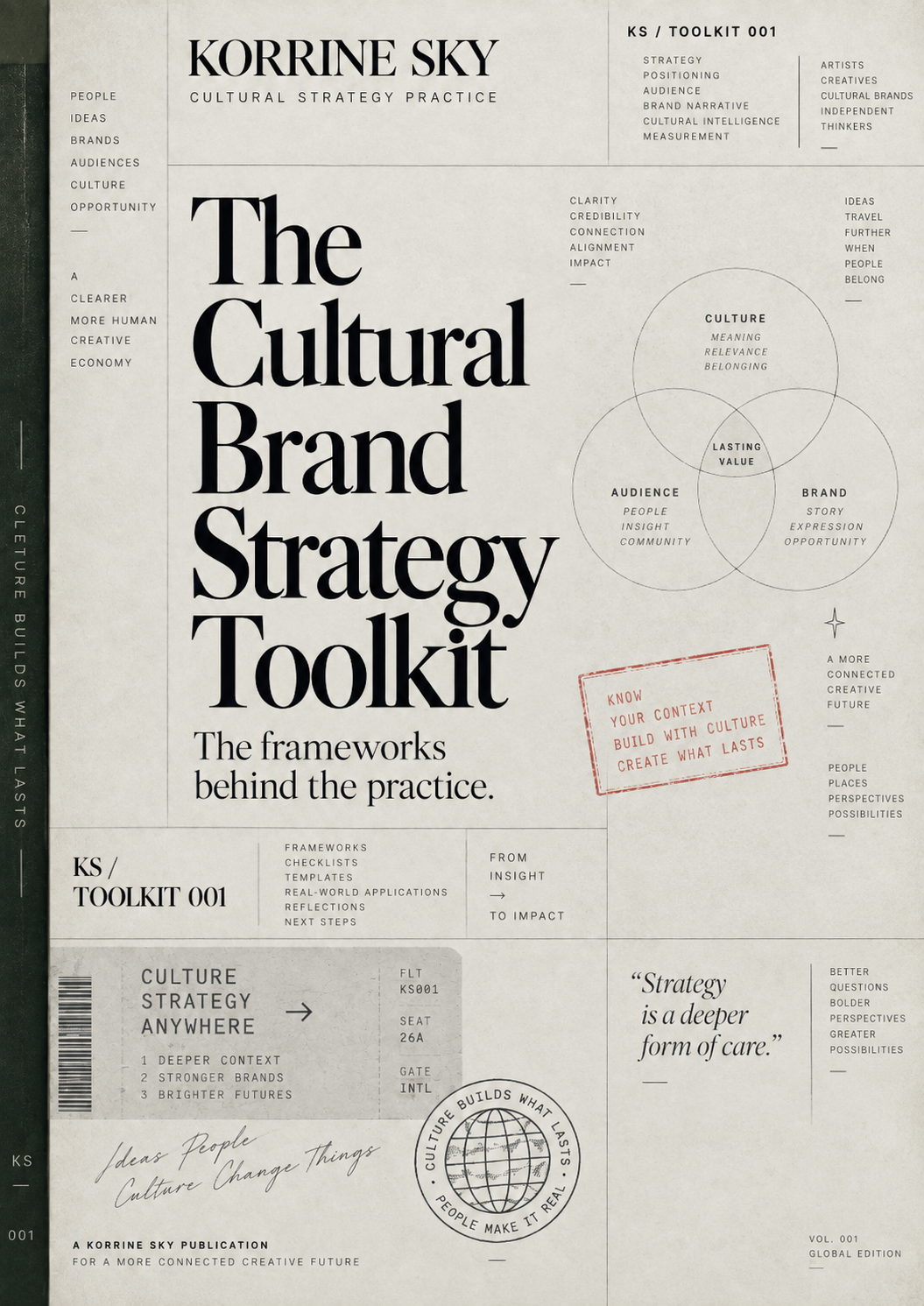
Cultural Brand Strategy 101

Six lessons on building a brand that moves with culture instead of feeding on it. Free, self-paced, and written the way I would teach it in a room. Each lesson takes about ten minutes and ends with something you actually write down.

  1. 01What culture actually is9 min
  2. 02The credibility gap10 min
  3. 03Clarity: what you actually stand for10 min
  4. 04Credibility: build the proof10 min
  5. 05Connection: the rooms and the next step9 min
  6. 06Run the Cultural Alignment Filter8 min

By the end you will have a written position, an honest proof audit, a scored activation and a plan for what to fix first.

Key readings

Where the thinking comes from.

Six books that shaped this practice, and the reason each one matters if you are building a brand inside culture.

A discipline rooted in power, context and care

What cultural brand strategy actually is.

A power-aware, care-centred practice that positions culture as a core strategic asset. It goes beyond aesthetics to interrogate how narratives shape systems, and shows brands how to earn trust through contextual intelligence, narrative accountability and authentic engagement.

Core pillars

  • 01Strategic storytelling
  • 02Cultural insight and trend forecasting
  • 03Identity, equity and belonging frameworks
  • 04Systems critique and community accountability
  • 05Consumer behaviour and emotional connection

Visibility

Value

Performance

Presence

Attention

Allegiance

Brands don't just need visibility anymore. They need allegiance.
Focus
Cultural trust and relevance
Metrics
Emotional loyalty and brand equity
Approach
Story-led, long-term
Culture
Systems-aware and community-led
Audience
Co-creators and advocates

Cultural brand strategy is the practice of building brands that move with culture instead of feeding on it.

It is power-aware and care-centred. It asks who a decision serves before it asks how it will perform, and it treats the community as a stakeholder rather than an audience segment.

  1. 01Who benefits from this, beyond the brand?
  2. 02Who shaped it, and were they paid and credited?
  3. 03What systems does it uphold, and what does it disrupt?

What cultural brand strategy is

The discipline of building brands that hold a defensible place inside culture: a clear position, evidence behind it, and a relationship with the community it depends on.

Where it sits

Upstream of marketing and communications. Marketing distributes the claim. Cultural brand strategy decides whether the claim deserves to exist.

What it is not

Not trend-chasing, not moment-jacking, not a heritage-month campaign. If it disappears when the budget stops, it was advertising, not strategy.

This work draws on cultural studies, critical race theory, intersectional feminism and media theory, so that every activation earns trust and redistributes power rather than borrowing both.

The problem

Most cultural activations burn budget and leave no trace.

The audience forgets, the press moves on, and the brand is back where it started. Here is what that costs, on both sides of the exchange.

In an era of cultural fatigue, brands chase trends without context, resulting in performative gestures that erode trust. Communities feel exploited when culture is extracted for marketing optics, deepening cynicism and weakening genuine loyalty. Without strategic understanding, both brands and communities suffer misalignment, superficial engagement and lost credibility.

The credibility gap

The distance between what a brand says and what people feel.

Cultural extraction

Use of culture for profit without reciprocity or respect.

Narrative disconnection

Brands speaking at culture instead of with it.

Mistrust and misalignment

The gap between brand promises and lived experience.

What it is not

  • A rebrand of DEI optics
  • A surface-level nod to Black History Month or Pride
  • Aesthetic mimicry disguised as cultural relevance
  • A performative campaign that avoids real change

It is a rejection of performative branding, where brands extract from culture without investing in it, or signal progress while preserving power imbalances. Cultural brand strategy requires rigour. It demands you interrogate your position, understand your impact, and earn your audience's trust.

For communities

  • Their aesthetics travel further than they do.
  • The reference gets the campaign, the community gets nothing.
  • Trust is spent quickly and rebuilt slowly.

For brands

  • Cultural moments are bought at the top and unravel in public.
  • Internal teams cannot answer why this, why us, why now.
  • Every campaign restarts from zero because nothing compounds.

Backlash

The correction arrives faster than the campaign can adapt.

Wasted spend

Budget buys reach, not belief, and the reach expires.

Lost partners

The people who could have vouched for you go quiet.

No compounding

Nothing from the last activation makes the next one cheaper.

Why now

Because the old playbook is broken.

We are living in an era of cultural fatigue, algorithmic identity and growing public distrust. Audiences are no longer moved by slogans or aesthetic gestures. They are asking deeper questions.

  • Do you see us?
  • Do you understand us?
  • Do you stand for something real?

In a time of systemic rollback, global unrest and shifting cultural power, brands that ignore context will lose relevance. Fast. Cultural brand strategy is not just timely. It is essential.

Who it is for

Brand leaders

Who want to build with meaning, not just marketing metrics.

Founders

Whose values lead their vision, but who need clarity and structure.

Institutions

Seeking relevance without tokenism.

Agencies and creatives

Tired of performative work and craving purpose.

It is for those who want to shift from trend to truth. From performance to presence. From storytelling to strategy.

The manifesto

Six tenets that govern the work.

Read them in order. Everything the tools score comes back to one of these.

  1. 01

    Culture is strategy

    Understanding how people speak, style and resist gives brands the insight to lead with relevance and integrity.

  2. 02

    Stories shape systems

    Narratives are structural. The right story can shift markets, influence policy and reorder power dynamics.

  3. 03

    Connection is currency

    Trust emerges where words align with actions. Brands that lead with authenticity earn lasting emotional equity.

  4. 04

    Power matters

    Every strategy must interrogate who holds power, and who gains or loses when narratives shift.

  5. 05

    Context over optics

    Surface-level gestures backfire. True resonance comes from deep historical and cultural understanding.

  6. 06

    Co-creation beats campaigns

    Communities built with belong. Those built for do not last. Invite audiences to shape your story.

Vision

What this is for.

01

Lead with integrity

Brands become cultural stewards, not extractors, investing in stories that uplift and endure.

02

Shift power

Redistribute narrative authority to communities whose voices have long been sidelined.

03

Build lasting allegiance

Move beyond attention metrics to cultivate true loyalty and emotional equity over time.

04

Foster systemic trust

Create frameworks of accountability that ensure cultural impact aligns with real-world outcomes.

Core principles

Power-aware, contextual, care-centred, rigorous.

01

Power-aware

Brands interrogate their position within cultural power structures.

02

Contextual

Strategies grounded in deep cultural and historical insight.

03

Care-centred

Investing in communities, not just extracting attention.

04

Rigorous

Scholarly research meets strategic storytelling for real impact.

Intellectual lineage

Whose shoulders this stands on.

This practice draws from cultural studies, critical race theory, intersectional feminism, media theory and brand strategy, standing on the shoulders of:

Stuart Hall

Representation, encoding and decoding, and the politics of meaning.

Cultural power is never innocent. It is always contested.

bell hooks

Intersectionality and the politics of representation.

Kimberlé Crenshaw

Intersectionality as an analytic of overlapping systems.

Cultural patterns of oppression are not only interrelated but are bound together and influenced by the intersectional systems of society.

Angela Davis

Critique of capitalism, race and liberation.

Audre Lorde

Difference, coalition and the refusal of single-issue politics.

There is no such thing as a single-issue struggle.

Douglas Holt

Cultural branding and myth frameworks.

Goals

What success looks like.

01

Earn trust

Align words with action to build unshakable emotional equity.

02

Redistribute power

Centre marginalised voices as co-creators and decision-makers.

03

Drive impact

Use cultural narratives to spark real systemic change.

04

Build legacy

Create frameworks that endure beyond any single campaign.

Reference this page as: Korrine Sky, Cultural Brand Strategy Manifesto, 2025.

Interactive tools

Three tools you can use right now.

Score the thing you are about to launch, audit what you are already publishing, then find which stage of Clarity to Connection you are actually at.

1Cultural relevance

3

Is this connected to the community and the context it sits inside?

1 · The link to the culture is asserted, not felt.5 · The community would recognise this as theirs without being told to.

2Community involvement

3

Were community voices co-creators, and were they compensated?

1 · Consulted late, credited vaguely, paid little or nothing.5 · Co-authors from the start, paid properly, named publicly.

3Contextual integrity

3

Does this honour the history and the nuance it borrows from?

1 · The reference is aesthetic and the history is stripped out.5 · The origin is understood, credited and carried through the work.

4Power awareness

3

Does this redistribute visibility and resources, or concentrate them?

1 · The brand gains, the community lends.5 · Visibility, budget and ownership move outward.

5Purpose alignment

3

Does this serve the mission and the community beyond the metrics?

1 · It exists because the calendar demanded something.5 · It would still be worth doing if nobody measured it.

Total score

15/25

Red, book an expert review

As designed, this reads as extraction rather than participation. Launching it risks the trust you already hold.

Weakest principle

Cultural relevance

Pause the launch date and rebuild the weakest two principles into the concept itself.

Send me this result

Sky, K. (2025) 'Cultural Alignment Framework', Culture & Commerce.

Boxes ticked

Start at clarity

Under three boxes means the position is not settled yet. More content will not fix that. Start at clarity.

Creators, artists and thought leaders

Clarity, be seen

Settle what you are known for, who it is for, and the sentence that everything else has to serve.

Ask yourself

  • What do I want to be called for?
  • Who is the audience I am actually building with?
  • What do I refuse to make?

Want this applied to your brand, with me in the room? See how I work.

Questions

How to use the Library.

What is free, where to start and how this differs from hiring me.

Yes. The six-lesson course, the readings, the glossary and the frameworks are free to read. Only the downloadable PDFs ask for an email so I can send you the link.